Your fair stories

Last week, I asked you readers if you had interesting fair stories to share. You sure did! (And I hope you enjoy them like I did.) Here’s what you sent me:

 *****

I was talking to a friend who told me that she writes her cell phone on her children's arms whenever they attend the state fair. I thought that was such a stellar idea. As the Mr. and I were preparing for our annual pilgrimage to the fair, I grabbed the fattest permanent black marker I could find. I grabbed the 5 year old man-child and proceeded to write my husband's cell number on his arm and then on the arm of our youngest. Without having to look at my husband, I knew he was giving me the look of “seriously?”, to which I confidently replied, “Hey, you never know.” Fast forward a few hours, and we are in the midst of crowd city, headed for the milkshakes. Husband turns to me with a look of slight panic and asks, “Where's the boy?” Before I could start freaking out, his phone rings. The man on the other end says, “I have your son, and we are on the corner of such and such.” Husband looks at me, and I just shoot him a smile of “I know.”

Shantell, Maple Grove, Minnesota

*****

When I was fifteen years old, we moved to Prince Edward County, Virginia—the hotbed of the civil rights movement in education—but that had only served to impoverish an already historically conflict-embroiled region. The Five County Fair was testament to this. 

The fair was a five-day event, school nights included. It was just at the brink of autumn, when you would want a jean jacket but often ended up slinging it around your waist until the cool of the evening, when the chill was enough for the jacket but not for the mosquitos. (The sign of an evening well spent in the South? Bug bites. But that finger nail crisscross and spit thing really does work.)

That night, my mother loaded all five of us kids in the van. We were fifteen on down to three years old and in the throes of that post-move funk that settles upon all children when the first thrill of novelty and change have worn off. My mother’s friend, a feisty lawyer woman and church friend who I was shadowing in case I wanted to be a paralegal, joined us for the trip.

The fairgrounds were set up lackadaisically in a great green field with occasional buildings marking talent shows, featuring songs like “Walking in Memphis” and sequined sister acts. I remember seeing a couple pigs and cows, but nothing like I have since experienced in southern Minnesota, where farming is a champion sport. Those high school days, I was city girlish about 4H Club and couldn’t fathom who would want to waste time fighting with a sewing machine.

A zipper ride with spiraling up-and-down seats caught my brother’s and my eye.

“You know these rides have no liability,” Lawyer Lady said. So far, she had refused to let her sons ride a single truck-mounted roller coaster or scrambler the whole evening. 

My mother was less jazzed about such things and sent us on ahead with tickets. I could almost hear her lawyer friend hyperventilating as we climbed on.

With a flat affect and grizzled beard, the ride operator flicked an eye at our seat belts—a glorified high chair strap and plastic buckle configuration—and slammed the cage door down on our box. He went around in a similar fashion to the other cars, making minimal eye contact and chewing a wad of tobacco. I felt a tremor of uncertainty, but my ten-year-old little brother was with me. As the big sister, you can’t afford to lose face. Back the man went to the operation keep—and then we were off.

To this day, I remember the sick way my stomach went up to my eyeballs that first time our car flipped upside down. The ride bore us up and down and made us spin, hurtling against our flimsy seatbelts the whole way. We touched the cage ceiling at one point, and even my brother screamed. I’m fairly sure there wasn’t a dry pair of underwear anywhere on that ride.

When the cud-chewing operator flicked open the cage door upon the ride’s conclusion, we bolted out like our golden retriever puppy from her kennel when we’ve been at church too long. We were both shaking and a little giggly, and between Drew’s girlish scream and my wet underpants, we never again spoke of what went on in that box.

To the lawyer lady’s horror and my mother’s chagrin, the ride then proceeded to go up in flames, almost the second we removed ourselves from the premises.

“I TOLD YOU!” Lawyer Lady’s brown eyes were almost as wide as her sons’, watching the grizzled ride conductor climb the not-yet-on-fire portion of the zipper ride with a small home fire extinguisher. There was a slight dampening of the furor of flames, but nothing too distinguishable from the distance at which we were standing.

There were a few stray claps for heroism. Screaming persons were hustled off the ride. (No one got hurt.) And then everyone carried on eating corn dogs, including my mother.

“We were THIS CLOSE.” My breath escaped in spurts, more from the excitement of my near scrape with death than from actual fear.

“The Lord has a plan for your life,” came the response from my Mom. “Today wasn’t your day.”

A vague thought of Stonewall Jackson style fatalism flitted across my mind. But then we got funnel cakes, and I forgot all about it. It’s true when they say youth has no sense of its own mortality.  

Dori, Mankato, Minnesota

jenna-anderson-V4A9Kn1Q9SQ-unsplash.jpg


The State Fair

The Minnesota State Fair starts in a week, and I’ve got jalapeño cheese curds on my mind—and stories.

Do you have a story about a trip to the fair (any fair) too?

If you’d like to share your fair memories in my blog next week, follow the instructions below. I’ll get us started.

*****

“When was the last time we came here together?” seventeen-year-old Flicka said as we passed through the entrance to the Minnesota State Fair.

I shrugged. “Well, we had the double stroller, so it’s been a while.”

No stroller this time. We would cover the place with three teenagers who could walk on their own. Who knew the state fair could be this easy?

At the girls’ request, we frittered away time in the livestock barns, shuddering at the largest boar who was slabbed out in his stall looking more like a three-quarter ton rock than an animal. We oohed at the cows who cuddled with their owners while they awaited their show times. We aahed at the sheep and goats who often shoved their heads through the bars to get a scratch behind the ears just like our own creature at home.

We floated through the agriculture building and the global market, the art exhibits and the butterfly room. We breezed through the gathering of humanity like we were riding a bike on a freshly tarred road, unlike the baby days when it seemed we were rollerblading through sand. And we ate many goodies: walleye cakes, fried pickles, multi-flavored cheese curds, poutine, honey ice cream, chocolate chip cookies. No sugar-induced meltdowns this time.

But as we sauntered by food offerings too numerous to conquer in a day, one particular aroma wafted me back to another time.

I was twenty years old again and drifting through the state fair with Boyfriend. We had managed to pay the entrance fee, but we were college students on a suffocating budget. Once inside the gates, we were strapped. Not even a dollar between us.

“That roasted corn sure smells good,” Boyfriend said.

“The best,” I said, eyeing the charred husks, the butter dripping off a patron’s chin after she chomped from a fresh cob.

“Maybe next time.”

But I had an idea. “Or this time.”

I shared my plan, and we strolled the fair with new purpose, our eyes trained on the ground. We most often found pennies, but went ecstatic when we spied silver.

“A dime,” Boyfriend said, his face splitting into a grin. “Lucky break.”

For an hour we were as alert as a dog hanging out under a dinner table, but soon, the mother of all ideas sparked: the arcade. Why hadn’t we thought of it before? We entered the house of games and searched every coin return slot.

I was breathless. “Three quarters!”

Finally we had what we needed for one cob. We scurried to the corn stand and dumped our fistful of change into a worker’s hand. We took our first bites. Now our chins were slick with butter. We sighed; roasted corn had never tasted more delicious.

Hardship probably creates the best memories. But visiting the state fair with a few easy teenagers and enough money for a cob of corn is okay too.


Now it’s your turn. What are some of your fair memories?

To have your writing published in my blog next week, submit it HERE. Subscribers, simply hit reply to this email. (Please include your CITY and STATE with your submission. And if you have a photo, I’ll run it with your story.)

Until then, enjoy the mini donuts!

jt-Hf_L19bhe_w-unsplash.jpg

*Names in this blog have been changed to protect my family, neighbors, and friends in the neighborhood, and in a nod of appreciation to the beloved Swedish author Maj Lindman, I’ve renamed my three blondies Flicka, Ricka, and Dicka.

Age schmage!

1 Kings 1:1 reminds me of you, Dicka texted me the other day.

Not knowing the verse by memory, my mind raced to all the tender sentiments my girl likely meant for me. Hard to imagine a statement about a mother’s love at the very beginning of 1 Kings, but who could know? I flipped the pages to find out.

Now King David was old and advanced in years. And although they covered him with clothes, he could not get warm.

I texted my kid a comeback, along with my signature string of emojis, but she wasn’t wrong. That ancient ruler and I were a lot alike—cold and old.

The first adjective is a no-brainer. Like people are fused to their cell phones, I’m attached to my sweater, and I’d never leave home without it. But it’s taken me a while to accept the second descriptor. At age fifty-one, am I truly old?

Relativity aside, yes. Just yes.


Years ago, when I was in my late thirties, a young mom approached me after church. With at least two little ones glued to her body and a diaper bag sagging her shoulder, she blew a piece of hair out of her face and flung out a question about raising children.

I looked around me, confused, and back at her. “Who, me? You’re asking me?”

She chuckled. “Yeah?”

Did she really think I knew what I was doing? I had hardly been at the job long enough to be an authority on parenting. I was scarcely old enough to have kids.

Except that I had worked the position for about ten years and was definitely old enough to give birth to the three who were at that moment begging me to buy them lunch at Qdoba. I could’ve even held grandma status, if life had dealt me a different storyline.

I think I mumbled something about what worked for me with whatever it was she wanted to know, but I left with one thought: My age scoots ahead of me faster than my mind can follow. And maybe I know more than I think because I’m older than I realize.


We like to say with age comes wisdom, but Oscar Wilde and I know that’s not always true. What is true is that life moves quicker than our mentality to adjust to it and swifter than the perception of our place on its timeline. My grandma was nearing her nineties when she said she felt like a young woman, but when she looked in the mirror, she saw an old lady. I inherited her sense of disconnect—which is everybody’s, I’m hearing—and I’ll be twenty-seven forever.

“Today is the oldest you’ve ever been, and the youngest you’ll ever be again,” Eleanor Roosevelt said. And I smile now because it sounds like we’re stuck right in the most wonderful spot ever, and it’s called NOW. And since there’s nothing I can do about time, I’m going to relax.

Age schmage. He’s got this.

Even to your old age and gray hairs I am he, I am he who will sustain you. I have made you and I will carry you; I will sustain you and I will rescue you.

giorgio-trovato-4t0kofpmmnA-unsplash.jpg

*Names in this blog have been changed to protect my family and friends in the neighborhood, and in a nod of appreciation to the beloved Swedish author Maj Lindman, I’ve renamed my three blondies Flicka, Ricka, and Dicka.

A broad place

Once upon a time, we lived in a tiny house. And in that tiny house, we hosted over one-hundred guests at a time for celebrations, thirty-two little ones (not all at one time) for parents needing respite, numerous relatives coming to catch up, and our girls’ many friends who stayed for a night—or a month.

In the old abode, space was limited; no oversized furniture possible. When we needed the pack-n-play for a baby, we wedged it into the room that served as both guest quarters and office. When it was set up, though, one side touched the desk chair and the other side pressed against the double bed, so no one could scoot around that portable crib. As for the ceilings, our very tall neighbor had to dip his head under our doorways, dodge our hanging kitchen light, and limbo his way through our basement.


Once upon these times, though, I stroll through our new house. It’s still under construction, but I consider its progress and possibilities. Someone expanded the residence in every way from what it once was. Each bedroom is larger than the living room in our old digs, and in the main areas, the ceiling is vaulted. The square footage bests that of our former situation by nearly three times, and I peer out the windows to a back yard that’s three times the size of our old one too.

We were called out into a spacious place, and I’ll never forget it.

Later, I sit with that idea, the Life Book open on my lap.

He brought me out into a broad place; he rescued me because he delighted in me.

I feel the weight of the unearthly, the lightness of truth, and my eyes fill. I know our future—the promise of the broad place—is our current dwelling too, and it isn’t just for us. And neither are the rescue and the delight.

Flicka watches me from nearby. I share what I see, and her gaze softens.

“When ancient words hit different,” she says.

I laugh a little now, but she’s right.


I have a recurring vision of our new home: Husband stands at the stove, cooking for the masses, while I wipe down counters, smiling. I already have memories there, and we haven’t even moved in yet.

My mind moves on to the world’s tight spots. I think of the struggles everywhere: addiction, poverty, abuse, bondage, depression, and more—the opposite of what’s in The Broad Place. So, what becomes of those squeezed and cramped and suffocated by life?

We’ll invite them to enter and abide with us in the roominess.

There’s space for everyone.  

edward-lee-FDi6yN68QdY-unsplash.jpg

 *Names in this blog have been changed to protect my family and friends in the neighborhood, and in a nod of appreciation to the beloved Swedish author Maj Lindman, I’ve renamed my three blondies Flicka, Ricka, and Dicka.

The tendril

Viewing your life through the lens of lack? It happens to all of us sometimes, but there’s hope. Enjoy this little piece from 2017.

*****

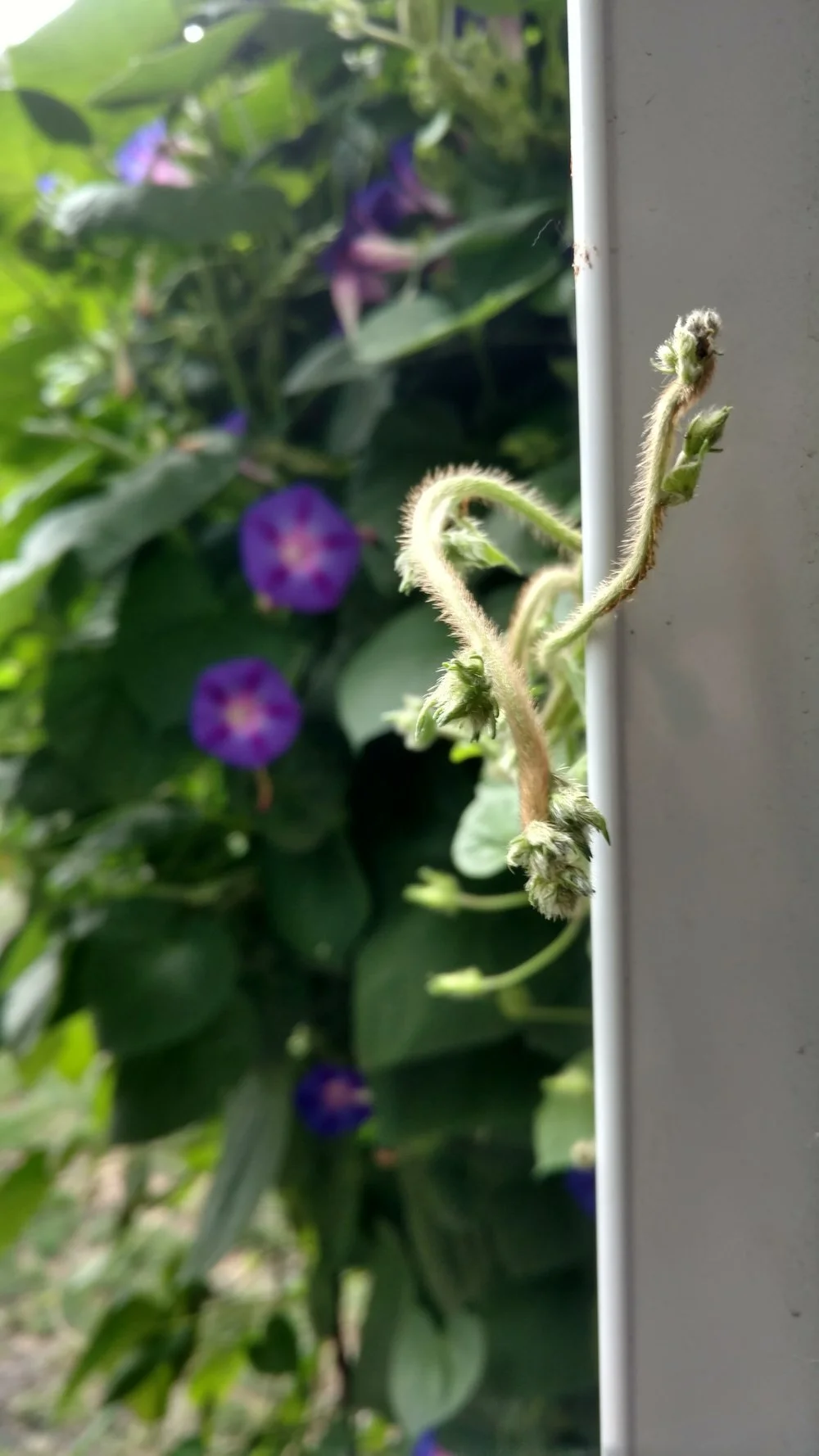
I watch the green baby each day as he twines his way up, clutching onto all the rungs I’ve provided. He’d grab onto me too, if I stayed still long enough. The tendril claws at the air in front of our back door. Maybe he thinks coming inside the house with me is a good idea.

“Oh, you don’t want what’s in there.” I brush him away from the doorway and poke him back into his trellis with Mama Morning Glory. “You’re better off out here.”

But soon I can see he doesn’t believe me.

I think of a little girl who once stayed with us. Her plate was always filled with food at our table, but she still reached for more. At one meal, she scooped up a man-sized serving of chili and circled an arm around the big—and only—bag of corn chips, pulling it to her chest. My family gazed at her scramble to have it all.

“How about eating what’s on your plate?” I said, hoping not to embarrass her, making sure a smile lifted my words. “You can always have seconds. And thirds. I’ll make sure you get full.”

But the look on her face told me she didn’t believe me.

The morning glories’ tendril grasps for more when it has what it needs. The little girl snatches another helping when her plate’s already full. But when I choose to live in the future—in the fear of scarcity—so I can’t even see the enough of today, am I so different?

… Be content with what you have, because God has said, “Never will I leave you; never will I forsake you.”

the tendril.jpeg

*Names in this blog have been changed to protect my family, neighbors, and friends in the neighborhood, and in a nod of appreciation to the beloved Swedish author Maj Lindman, I’ve renamed my three blondies Flicka, Ricka, and Dicka.

Triumph

When I think of the Olympic Games, I think of American sports commentator, Jim McKay, at the 1976 summer Olympics in Montreal. Wearing a turtleneck under his polyester sport coat, the man leaned into the camera one evening and said all manner of meaningful things about THE TRIUMPH OF THE HUMAN SPIRIT. A breath caught in my six-year-old chest because his words, vast and laced with the fear of God, rattled me. And I loved it. Also, I got it in my young head that Quebec was a communist country where her people were surely oppressed—and wasn’t that all so very sad?—but I digress.

That same Olympics of ’76, my siblings and I huddled around our black and white TV to watch Romanian gymnast Nadia Comaneci win the gold. During the winter games that year, we witnessed American figure skater Dorothy Hamill capture the gold too. And those two athletes grabbed my heart, mind, and all control over my sense of style for a couple of years.

I was impressionable at age six—who isn’t?—and Mom let me get both the long-sleeved white leotard (with red and blue stripes down the sides) like Nadia AND the bob haircut Dorothy made famous. I pranced around on our front lawn that summer performing gymnastic sequences that ended in crisp round-offs. When I finished my routines, I threw my arms straight in the air, back arched, to signal it was time for my audience, a.k.a. siblings seated on the cement front steps, to applaud. And I think they did—probably while slapping at mosquitos and tending to drippy popsicles.

Come winter at the ice skating rink, I performed simple spins, my head tipping back during each rotation so an onlooker might notice the droop of my Dorothy Hamill wedge. After all, what was a twirl without the hair to punctuate it? And I think that was the same year I took skating lessons at the hockey arena in Thief River Falls, Minnesota, and made it into the ice show. Not only was I cast as a townsperson in Cinderella, I was cast as a male townsperson who got to wear a pair of knickers with matching vest, my blonde hair stuffed into a short brown wig. Backstage, somebody else’s mom drew a mustache on my upper lip with a black Sharpie, and not even Vaseline could erase that manly mark for at least a few days. But again, I digress.

Olympic memories explode in my brain like the popcorn I plan to munch with the family while watching the competitions this year. In 1992, Soviet Unified athlete Tatiana Gutsu, “the painted bird of Odessa,” brought the awe to me like the gymnasts of my childhood. In 2008, American swimmers, Michael Phelps and Ryan Lochte, demolished the world—and our belief that humans have physical limitations. In 2018, American track and field runner, Tyson Gay, charmed us even more with his beard than his speed. That same year, Canadian ice dancers, Scott Moir and Tessa Virtue, melted the ice with their chemistry, and we wanted them to never stop skating together EVER, please, and admit they were a couple in real life too because we couldn’t sleep without knowing for sure.

Starting tomorrow, Tokyo is the site for the 2021 Olympic Games, and I already feel the inspiration coming on. I’m sure we’ll hear about athletes doing more of life with coaches than parents, 3:00 a.m. wakeup alarms every morning of every week, and gyms that break bodies into perfection. Nothing like a good human interest story, replete with its physically exhausting and emotionally trying details, to jostle my life of comparable ease.

Oh, that triumph of the human spirit. It gets me every time.

*Names in this blog have been changed to protect my family and friends in the neighborhood, and in a nod of appreciation to the beloved Swedish author Maj Lindman, I’ve renamed my three blondies Flicka, Ricka, and Dicka.

Gone soon enough

They say life is what happens while you’re busy making other plans.

And like you, our family knows a little something about other plans.  

In early December 2020, we moved out of our North Minneapolis house, believing we’d be humping boxes into our new home in Fridley by February’s end. Our purchase agreement said as much—and so did our New Year’s card. And we all know grand pronouncements in holiday cards are gospel.

But here we are in an aging 2021 and still not in our new house. It takes time for someone to finish a gutted dwelling we’re learning, so we dangle in the gap between two parts of our lives: the old house past and the new house future. And those parts were supposed to almost touch. Instead, our three-month dalliance as renters in Lauderdale has matured into a seven-month housing relationship, and I’m stunned.

Who knew we’d spend numerous seasons in the in-between? Not us, say our drawers of scant kitchen utensils and bins of limited clothing items. We haven’t seen a bed frame in months; we threw mattresses on the floor for our interim living. The TVs stayed in storage too. Why bother setting one up? We’d be gone soon enough.

While I squirm at the passage of time, life strolls by our windows—and it’s a peaceful one. I haven’t heard a gunshot since our last night in the old place. The freeway buzzes in the distance, telling me we’re still in the city, but I forget because it feels like small-town life, with rabbits—and a deer once—dotting the landscape.

Charming houses, vibrant gardens, and tranquil nights surround us. Passers-by smile like they know us. Our temporary neighbors wave at us, and I remember I used to be a neighborhood lady, interested in connections. But what about here? What about today in this unplanned chasm? The time is too short to forge friendships. We’ll be gone soon enough.


Our girls, caught in the pause with us, observe much. Each day, the red golden retriever next door loves his human, and even off-leash in the unfenced yard the dog obeys, joy wagging his body while his man lobs him a ball.

“Rosco’s out with his dad again,” Flicka says, eyeing the happenings on the grass over there. We don’t know the dog’s real name—or his owner’s—so we pretend.

“Do we even know Rosco’s a boy?” I say in passing.

“Just a guess.”

With a quick glance, divided attention, and a half-heart, I witness the bond between animal and owner. It’s sweet, but the thought trails off. We’ll be gone soon enough.


I sit cross-legged in my favorite chair in the living room, sipping coffee, my back toward the view of the neighbor’s yard. The window near me is cracked open several inches to give Dicka’s orchid a fresh breeze, and it lets in sounds too. I hear swishing.

With a long-handled Chuckit, Rosco’s dad scoops a tennis ball out of the bushes by our window. The dog vibrates in expectancy, his tail thwacking the air. The man chuckles. A pain flits through me, and in that second I know the truth: I packed up most of my personality in a box months ago, and it’s lost somewhere in the storage unit, along with the stuff we own that doesn’t matter.

But I can get it back.

I ditch my coffee cup and venture out. Rosco’s dad acknowledges me with a raised hand. I can tell his life is always poised for a friendly chat. I say I’m sorry it’s taken more than seven months to meet him. See, we didn’t think we’d be here this long, I explain. Minutes later, I return to our rental with new information (the dog’s name is Mulligan or “Mully”) and an invitation to the next meal the man (his name is Jeff) grills out with his family.


On this side of eternity, we can’t know what goes away and what lasts, so what if we take ourselves out of the boxes and do life anyway? I’m done with waiting. From here on out, I plan to imagine today is the only day, no dangly voids or lagging spaces to stall me.

After all, we’ll be gone soon enough.

*Names in this blog have been changed to protect my family, neighbors, and friends in the neighborhood, and in a nod of appreciation to the beloved Swedish author Maj Lindman, I’ve renamed my three blondies Flicka, Ricka, and Dicka.

Dream answers--and freedom

Last week, I asked you readers to share interesting dreams you’ve had and if you think they mean something. Take a guess at the number of submissions I received.

The answer? None.

I smiled when I read your many responses, though, confirming my pregnancy dream meant new and big opportunities ahead for me. (And yes, of course I’ll keep you posted!) One reader even said she felt my dream was “heaven sent”.

You’re absolutely the best, all of you. I hope you know that.


On Sunday, our country celebrated another birthday. Freedom is still flowing through my thoughts today. I wrote the following piece three years ago, but the reminder I’m free never gets old.

*****

With each explosion of fireworks, Lala, our dog, presses harder against me, and I feel her trembling. She doesn’t understand there’s a celebration going on and no one’s really bombing us.

Our dog isn’t the only one who struggles; I’m told the neighborhood’s many canines quake in their coats around this time each year, sometimes even refusing to step paw outside to answer nature’s call. They’re free to go out, of course, but to them, the pyrotechnics in the night sky signal sure terror, and the endless pops imprison them in fear inside their houses.

Unlike Lala, I know I’m free. And I’m free in more ways than I live.

Freedom frames my thoughts as I drive east on Dowling Avenue, pointed toward the grocery store where I’m free to spend my money how I like before it closes early for the July holiday. On my way, I pass a house where two large tents festoon the side yard. Ribbons of smoke curl skyward from two grills. A tall slim man approaches one of them and maybe he’s holding a spatula, but who cares, because he’s dressed in exactly two clothing items: a red Speedo and an American flag worn as a cape. Husband’s at work, but I have to phone him this minute anyway because the brand of freedom I just witnessed should be shared with others.

As I drive on, I count my freedoms on Independence Day, and like the sighting of the guy in the Speedo, they surprise me:

 I’m free to live a life that doesn’t look like the next person’s.

I’m free to do the right thing, even when it’s hard.

I’m free to serve others more than I do.

I’m free to keep the words that are in my head out of my mouth.

I’m free to not worry today. Or tomorrow.

I’m free to tell people I love them, even if it’s likely they won’t return the sentiment.


How are you free?

*Names in this blog have been changed to protect my family, neighbors, and friends in the neighborhood, and in a nod of appreciation to the beloved Swedish author Maj Lindman, I’ve renamed my three blondies Flicka, Ricka, and Dicka.


What's in a dream?

I’d love to hear from you today, reader.

First, I’ll tell you my story. Then if you’d like to share yours in my blog next week, follow the instructions below.

*****

The turn from one year to the next is always a big deal, but flipping the calendar page from June to July this year—the halfway mark of 2021—feels significant, and the air sizzles with more than the promise of pyrotechnics exploding the night sky in a few days.

Do you sense something too?

Last night, on the cusp of THE TURN, I dreamed. And in the dream, I was pregnant.

They used to show up often, those gestational night visions, years before the kids. And because I wasn’t ready for my life to change like that, the dreams alarmed me.

The one last night was different.

In that nocturnal world, my belly grew bigger by numerous inches—like the three times in my real life. Nothing unusual. Then something new came—and fast. My stomach grew and grew until it poked out at least four feet in front of me. No way could I circle my arms around it. How would I manage life like this?

I told Husband the news (as if he couldn’t see the four-foot protuberance.)

“This is great,” he said, his smile gleaming. “What’s one more?”

I worked the math. An eighteen-year gap would span our youngest, Dicka, and this One More.

“But how will this go?” I considered our girls’ reactions to a new sibling and the likelihood of a baby with disabilities because of my advanced maternal age.

I went to share the latest with the girls, and two revelations dawned. First, the pregnancy was only a dream, and second, I knew the meaning of it.

The “baby” was a fresh opportunity for me—something that would grow so big so fast I wouldn’t be able to wrap my “arms” (or mind) around it at first. Husband would be happy for me and welcome this new thing in my life. Still inside the unconscious realm, Flicka agreed with my interpretation. And I woke up, wondering.

Now, how about you? Have you had an interesting dream lately? Do you think it means something? If you’d like your dream (and thoughts about it) published in my blog next week, submit it HERE. Subscribers, simply hit reply to this email. (Note: Please include your CITY and STATE with your submission.)

Dream on, dear reader! I can’t wait to hear all about it.

*Names in this blog have been changed to protect my family and friends in the neighborhood, and in a nod of appreciation to the beloved Swedish author Maj Lindman, I’ve renamed my three blondies Flicka, Ricka, and Dicka.

A Homeowner's Guide to Fun Times

I noticed water dribbling from a line in the basement one day. After listening to my description of the problem, the gas company sent over a technician to inspect our air conditioner. The unit was fine, but I had forgotten one important task: to change the furnace filter after we sanded our wood floors the previous week. Because of my oversight, the filter clogged, forming condensation on the line, and water dripped and pooled on the floor. Now I stood outside—the technician next to me—staring at the side of our house.

“See? You’re gonna have to do a patch job right there,” he said with a sniff, pointing at a small area on the stucco near the foundation.

I frowned. “Does this have anything to do with our air conditioner?”

“Naw. I’m just letting you know what you’ve gotta fix at some point.”

He moved on to the next item, a new furnace, on his for-us-to-do list.

“That thing’s gonna conk out soon,” he said, bobbing his head, maybe hoping his steely eye contact would break me. “Better replace it now.”

“We’ll see,” I said.

My mind flitted back to a different technician from a few months earlier who had checked our furnace and pronounced it good. “They don’t make ‘em like this anymore. Don’t replace it until it totally dies,” he had said.

The current technician’s words pelted me, and before he left, I agreed to a duct cleaning. Even though it had been my idea first, his face grew the smug look of a successful hawker.

Not all the repair people visiting our home were so crafty, though. Over the years, I noted the differences. There were those who got the job done in little time with minimal talk, and those who wove stories into their work, their visits leaking into my day.

“You wouldn’t believe the stuff I see in people’s basements,” said one technician as she swapped out our old water meter for an updated one.

“Oh? Like what?” I said, not sure I wanted to know.

“One lady had shelves lining her basement walls. Kennels of dogs on those shelves. Sometimes even a couple of dogs per kennel.” She pried off a bolt.

I cringed. “That makes me sick.”

“At least forty of them, I’d guess. Maybe more.” She rigged the new equipment into place and tightened the bolts again. “I told her she’d better let them go. Give them away to good homes and all that.” She swiped an arm across her forehead. “I reported her to Animal Control as soon as I left her house.”

“Oh, good.”

The repair woman finished the job, leaving me with a shiny, new meter. But I also had a bad taste in my mouth. Sometimes stories won’t let you go.


Husband and I evaded window washing for eight years, and in 2010, we decided to replace the windows altogether. The installation guys were efficient and meticulous. Along the way, they pointed out the miniscule details of their work—the hidden nooks and crannies no one would ever see. And at every turn, they tidied up after themselves.

Spurred on by the call of hospitality, ten-year-old Flicka whipped up a baked treat for the workmen, since they were doing such a good job. As I plucked weeds in the garden, she emerged from the house, holding a plate of fresh goodies. She offered a treat to one of the men and stood there, fiddling with the edge of her shirt, eyeing him as he chewed.

“Wow,” he said, smacking his lips. “These are good.”

I ducked into the house to sample her baking. The hot, fresh mounds looked like muffins but tasted so bland I skimmed her recipe. Had she forgotten the vanilla, cinnamon, AND sugar?

All around, the home improvement project was a success. The windows were beautiful, the workers fastidious. And over those few days, Flicka got a solid start on her hostessing skills.


Four years after the new windows, we eagerly awaited the installation of a new metal roof. Early-morning pounding on the house—the perfect pairing with my French Roast—had never sounded so sweet. I spoke with the workmen, but my questions were met with smiles and shrugs. I soon learned the only English speaker on the job was the supervisor.

My mind skipped back to the roofers of my childhood. Their overly-tanned skin, slick with sweat and oil, melded with the Hair Band anthems thrumming from their boom boxes. In stark contrast, the workmen on our roof in 2014 kept their shirts on—a lesson or two learned about the ozone since the 1980s, I suppose—and blasted Vivaldi, Corelli, and Handel.

I savored the lovely music, but twelve-year-old Ricka and ten-year-old Dicka saw the chance for fun. They scrambled to their upstairs bedroom, slid open a window, and peeked out at the workmen who were tearing off the old roof.

“Yoo-hoo!” they called, then ducked under the open window. After a few more hoots from the girls, one of the workmen tossed a tarp over the opening. The girls inched it aside to chirp at them again before crumbling to the floor, giggling.

“Girls,” I said, “you might be getting on their nerves.”

Just then, one roofer lifted the tarp and warbled back at the girls.

During that three-day job, I heard more classical music than I had since my piano recital days, and no one watched TV. The excitement of the new roof was entertainment enough.


Interesting people are tucked away everywhere. We venture out and see them in stores or on the streets and learn from them. But sometimes fascinating strangers come right into our homes and add zest to our lives with their quirks and stories.

And if we’re lucky, they’ll fix something while they’re at it.

*Names in this blog have been changed to protect my family, neighbors, and friends in the neighborhood, and in a nod of appreciation to the beloved Swedish author Maj Lindman, I’ve renamed my three blondies Flicka, Ricka, and Dicka.

Control

Maybe the concerns of our times are bigger than botched epidurals, spinning heads, and broken alternators, but here are some stories anyway. Enjoy!

*****

“Let’s have you get up,” the nurse said. “Time to move around.”

I sat on the edge of my hospital bed that day in 1999, placed my bare feet on the cool tile, and stood. I crumpled to the floor with a thud. I pushed myself up, but my legs wouldn’t support me. What was happening? The strength in my thighs was gone.

Surprise flitted across the nurse’s face and vanished. She pasted on a smile and called for an orderly. The two of them helped me back into bed and scurried away, deserting me to my thoughts. I had just given birth to Flicka, our first baby, and now something was wrong with my legs.

Over the next several hours, a number of doctors breezed in to examine me. They furrowed their brows and spoke to each other in muted voices.

“We’ve never seen this before,” my doctor said out loud, and I wished he hadn’t.

Fear writhed inside me. When everyone left the room, I turned into my pillow and cried.

“Maybe it was the epidural,” Husband said, “and maybe it’ll wear off soon.”

In the middle of the night, I phoned my youngest sister, a nurse.

“I’ve heard of this before. It sounds like you’ve had nerve injury, but you’ll get better in time.” Her tone soothed me, rocking my fears to sleep.

The hospital staff said I would be released when I could walk again. So, a few days after Flicka’s birth, the nurses gathered to watch me walk down the hallway of the OB ward. After a few steps, though, my legs gave out, and I collapsed. Heat prickled my neck, and sweat beaded on my face. I bit my lip, determined to get off the floor by myself. But I couldn’t.

On day five, through sheer grit, I locked my knees enough to pass the hall walk test, and the hospital discharged me. My muscles still lacked strength, though, so Husband assisted me with everything.

One night, I felt confident enough to get up with the baby. I scooped her from her bassinet, but just then, my knees buckled. Before I hit the floor, I angled my body to bear the brunt of the fall. Husband awoke and sprang from bed.

He assessed our newborn, still in my arms. “She’s fine, but are you okay?”

I sat on the floor, a weepy mess. He put the baby back in her bed and lifted me.

At the four-week mark, I met with a neurologist.

“You’ve suffered nerve injury. This happens to one in ten-thousand women who’ve had epidurals,” he said. “You’ll eventually heal.”

And I did. But in those early days, the fear of the unknown tangled me. It wasn’t what I had planned. And I knew I couldn’t control my healing—or my life.


As soon as I switched my eyes open one morning in 2004, the room whirled around me, and fear climbed up my throat. Vertigo had shown up for unwelcome visits before, but today was more complicated. Husband was gone on international travel for work, and my only companions were four-year-old Flicka, two-year-old Ricka, and the unborn baby who swam laps in my belly.

I eased myself to sitting position. It was a Sunday morning, and I had agreed to volunteer in Ricka’s classroom at church. Maybe I could still make it. Maybe my head would clear in time. But the room kept up its merry-go-round antics, and nausea roiled my stomach. I reclined on the pillows.

“I need your help, girls,” I called out to them, my voice brimming with the promise of adventures. “How about we do something different today?”

They scrambled downstairs from their bedroom and clambered up into the bed with me.

“Okay,” Flicka said, her eyes bright. “What will we do, Mama?”

“First, I need you to go into the other room, and look on that bookshelf for the church directory.” I described the slim book, hoping she would spot it even though she couldn’t read yet.

She found it and presented it to me like a scavenger hunt prize. I flipped through its pages and made the phone call that relieved me of my duties for the day.

“Now,” I said, “let’s get you two some breakfast.”

I sat up again, but the swaying room threatened to pitch me over the edge. I slid from the bed and lowered to my hands and knees on the floor.

“What are you doing, Mama?” Ricka said, cocking her head and patting me lightly on the back as she accompanied me on my slow crawl to the kitchen.

“I’m dizzy today,” I said, casting my words in cheery colors. “This helps me.”

But even on my hands and knees, I almost toppled. Changing my mind, I inched back to the bedroom. Safely in bed again, I doled out instructions to Flicka.

“New plan, honey. You get to make breakfast for the two of you. Isn’t that fun?” She squealed and jumped up and down. “Now listen. Push a chair up to the kitchen counter. This time it’s okay for you to stand on it. Open those cupboard doors above the sink and take down some cereal boxes. Help yourself. I trust you.” Flicka did what I said. “Now come and eat cereal in my bed, and we’ll watch something on TV.”

As my head spun, so I spun reality for my girls; they were too young to hear I didn’t have control over much of anything that day. And I didn’t want to hear the words out loud either.


The Honda’s windshield wipers slicked away the falling snowflakes as I navigated through the sluggish traffic of Minneapolis’ morning rush hour one day in 2014. I had already dropped off Flicka at the light rail for her ride to school. Now I had to drive through the downtown to deliver the other two girls to their school. Our houseguest at the time, nine-month-old Damian, was snug in his car seat in the back, and Ricka and Dicka played peekaboo with him.

As I approached the center of the downtown, I glanced at the dashboard. The lights flickered, and the gas and temperature gauges convulsed. Warning lights flashed. Nervous about the car’s behavior, I moved into the left-hand turn lane. If I could make it around the corner, I would pull over, but the stoplight snapped to red. I clenched my jaw and waited for the green arrow. The dashboard darkened for a second and lit up again.

“Girls, pray!” I hollered into the back seat. And they did.

The stoplight finally shot me a green arrow, and I held my breath and applied the gas. The car chugged forward. Would it survive through the left turn? If it stalled in the middle of the intersection, then what? My thoughts chattered with possible scenarios. I had little power over my vehicle and no control over the outcome. The car lurched left.

Once through the intersection, I pelted myself with two questions: Should I pull over? Or should I keep going? I flipped between the options but decided since the vehicle was still moving, I shouldn’t stop it.

The car propelled us over the Central Avenue Bridge and closer to our destination across the river. What was going on under the hood? With the flickering panel and spinning dials, I was either maneuvering a time machine, or the alternator was on its way out. Just a few more turns to go…

I pulled up in front of the girls’ school as the dashboard lights blacked out for good, and the car sputtered to its death.

“We made it,” I said, incredulous, the muscles in my neck taut.

The girls flung the car doors open and dashed toward the building, blowing kisses and we-hope-it-works-outs over their shoulders for the baby and me. I called for a tow truck, unclasped Damian from his car seat, and traipsed into the school with him to wait where it was warm.


We humans navigate life, convinced we have control. In the flash of crisis, though, in the loss of control, is freedom from the heaviest weight of all—the burden of believing we can master our own lives. And here’s more good news: With our fallible intentions and unreliable bodies, we’re not deserted to orchestrate our ways alone.

I know the thoughts that I think toward you, says the Lord, thoughts of peace and not of evil, to give you a future and a hope.

hallway-5979689_640.jpg

*Names in this blog have been changed to protect my family, neighbors, and friends in the neighborhood, and in a nod of appreciation to the beloved Swedish author Maj Lindman, I’ve renamed my three blondies Flicka, Ricka, and Dicka.

Heat wave

“This is miserable,” the people around me say, plucking the fabric of their shirts away from their chests.

They’re sweaty and cranky, so I go silent. I can’t lie; I love this heat wave. The peer pressure to complain runs strong, though. Like in high school when my friends griped about diagramming sentences in English class.

“This is stupid,” they’d say on their way to the chalkboard, whispering so Miss Helgeson couldn’t hear them.

To fit in, I nodded. But I loved dissecting those sentences so much I thought my heart might explode. I even pictured one day sitting in heaven—in a coffee shop in the heart of the celestial city—drawing horizontal, vertical, and diagonal lines on paper, identifying groups of words and bringing them structure at last for all of eternity.

Husband walks to the thermostat now and clicks it lower by a degree or two, and I remember I’m writing about temperature and not grammar.

Living in Minnesota, I’m chilled for seven months out of every year and continually scheming ways to warm myself amongst family members who like it brisk. If I were a single lady, I’d pass on the air conditioning altogether, but here I am doing life with this overheated group.

Husband proposes traveling to Iceland sometime and staying in an ice hotel there. I read about the novelty accommodations. Architects and designers have made sleeping on blocks of ice inviting. They’ve even created amenities like frosty cocktail bars and ice-molded dinnerware to add to the adventure. I shiver and close out the tab on my online search.

I saw a YouTube video once about why summer is “women’s winter.” In the skit, the women at the office wear furs and still freeze, their lips bluer than their skin, while the men lounge in front of their computers in shorts and tank tops while tossing around a beach ball. One commenter says, “I never truly understood this sketch. Then I visited America. Now I understand.” Yes, in this country the women stow space heaters under their desks in July.

I recall bundling up to go sledding with the kids one winter. My many layers turned me into an immobile sausage. With that memory in mind, I say to one of my girls, “There’s only so much clothing you can put on, but to cool down, you can always take off more.”

She snaps her gaze at me. “I think the real expression is just the opposite.”

I recollect my Norse Mythology class in college and the knowledge that Hel—the underworld for the ignoble dead—is located in Niflheim, a realm of primordial ice and cold. To imagine hell is freezing tells me much about the ancient Scandinavian peoples and what they found insufferable. Enough said.

The forecast promises a high of 99 today (with a heat advisory), up from yesterday’s 95 degrees. Whether it was President Truman who said it first or not, the quote is true: If you can’t stand the heat, get out of the kitchen.

To twist this adage for my purposes, I’ll say this much: The lawn chair in the “kitchen” is calling me right now, and I’m heading out there with my iced coffee ASAP. You’re welcome to join me, if you can stand it.

This central air is too much.

vicko-mozara-m82uh_vamhg-unsplash.jpg

*Names in this blog have been changed to protect my family and friends in the neighborhood, and in a nod of appreciation to the beloved Swedish author Maj Lindman, I’ve renamed my three blondies Flicka, Ricka, and Dicka.

Improvements

Two weeks into our home ownership in 2002, curiosity nibbled at me like a mosquito at dusk in a Minnesota summer. What was underneath the beige carpeting in the bedroom? All the other rooms on the main level had hardwood floors—except for the kitchen, which was suffocated in a dated linoleum. But how could I rest if I didn’t know about the bedroom? And how could I know if I didn’t take a peek?

Bolstered by the expression “it’s easier to ask for forgiveness than to ask for permission,” I waited for Husband to leave for work one day. After he was gone, I peeled up a corner of the bedroom’s carpeting, which flowed into a tiny hallway. It was all or nothing. If I ripped up some of it, it would all have to go. So it all went, and I stood back, assessing the scene.

The bedroom floor was paint-spattered, and the hallway was covered with old, brittle linoleum. I chipped away the ancient flooring to discover a wooden floor grate, gummed up with a black, sticky residue. But I was a visionary; cleaned off, it would be beautiful. And it wouldn’t take too long to refinish it, would it?

When Husband returned home, my impromptu project startled him. He wasn’t happy, but had I lit the proverbial fire under him? Yes, I had. So after lugging out the old carpeting, which I had left in the dining room in more of a pile than a roll, he borrowed a floor sander from my Uncle K. The floor project scaled up the mountain of priorities like a pro rock climber.

The refinishing job was more involved than my initial estimate. Before sanding, we needed to remove, by hand, all the staples and nails that had secured the carpeting. Husband did the work in flip-flops.

“Your choice of footwear scares me,” I said.

“You worry too much.” He swung the claw hammer at a nail. It missed its mark but found his big toe and plunged into it.

When the bleeding stopped, the work resumed. Husband and I completed the sanding, applied three coats of polyurethane, and eventually the floors gleamed.

I sidled up to him with a coy smile. “Now aren’t you glad I gave you the nudge to do this?”

“Hm,” he said.


In 2008, after someone kicked in our door, catapulting its lock mechanism across the living room, we decided we should probably replace it, and this time the door wouldn’t have a window in it to showcase the inside of our home to eager onlookers. Husband bought a new one—three times the weight of the previous one and inches bigger—from Siwek Lumber in northeast Minneapolis. He showed me his choice, knocking on it to flaunt the strength of the solid, six-paneled oak beauty.  

I nodded. “Nice.” A thought zinged me. “When you trim it down, you’re gonna cut the same amount off each side, right?”

He tossed me that look. “Of course.”

Hanging a door seems simple enough, but when one hangs a door in an almost century-old home, one quickly learns that nothing about that home is exact—particularly the size and shape of the doorways.

In the garage, Husband made some adjustments to the slab of oak and muscled it into the house to check the fit. Not quite right. He heaved it back out, made more adjustments, and hauled it in again. Still no. In and out, in and out.

After six times of trying the door on for size, it slid into place. He attached the hinges and inserted the lock and handle. The color drained from his face, though, and he shot me a withering look, one I could tell was aimed at himself more than at me.

I scrutinized the door. “Oh no.”

The right answer was to not cut off the same amount on both sides. The door lock and handle plate no longer fit. I cringed. Silent, Husband humped the door back out to the garage, climbed into his truck, and drove to Siwek’s for the second door purchase of the day.


Husband’s basement bathroom project spanned a few years. After the plumbing was roughed in, he plugged the hole—where the toilet would eventually sit—with an old rag. One day, however, we discovered a putrid mess all over the bathroom floor. When the repairman came, he told us something interesting; the built-up gases had sucked the rag into our main drain sewer line, causing the backup and spill. We cleaned up the nightmare, and Husband stuffed another rag into the hole. After the second Raw Sewage Fiasco of 2006, however, he learned about $2.00 rubber plugs.

In the spring of 2007 when I returned home from a trip to London with Mom, Husband led me down the basement stairs. Excitement flipped my stomach.

“Close your eyes,” he said before we got to the bathroom.

When I opened my eyes again, my dream materialized. “It’s perfect.”

“When I put in the heating mat under the tile, I didn’t get it far enough that way.” He pointed out an area on the floor, shaking his head. “There, of all places.”

“It doesn’t matter.” I drank in the details of the new room. He had done the ceramic tile with precision and painted the walls the same color as the green bead in my favorite bracelet. “The floor is toasty from where I’m standing.”

He frowned. “Well, it irritates me.”

I waved away his concerns. “Who needs warm feet when they’re using the toilet? And when they’re done showering, why the need to step onto a warm floor? They’ll probably be overheated at that point anyway.”

I may not have convinced Husband, but we had a new bathroom, and that was enough for me.


Over the years, we’ve learned some home improvement lessons. The mistakes have been funny or maddening, the process frustrating or exhilarating. And sometimes the ordeals made my back ache—like the time Husband, in a burst of paternal nesting, renovated the kitchen while I was pregnant, and every day for six weeks, my big belly and I had to bend over the side of the bathtub to wash dishes.

But that’s a story for another day.

tools-1183374_640.jpg

*Names in this blog have been changed to protect my family, neighbors, and friends in the neighborhood, and in a nod of appreciation to the beloved Swedish author Maj Lindman, I’ve renamed my three blondies Flicka, Ricka, and Dicka.

The Juno house

Lately, I’ve thought about the guys from the group home. I don’t know why they’ve come to mind, but there they are, still living with me in my memories thirty-one years later.

*****

If only I had known then that Dick—lunging at me with unsteady feet and incoherent speech when I stepped inside his house—would still make me smile decades later. But I didn’t, and his jarring welcome was our first meeting. My brother and I were already set to move in with the man and his two roommates, Allen and Tim. I assessed my surroundings—the stains on the plaid couch cushions, the smoke-filled atmosphere—and nervousness rattled me. What had we gotten ourselves into?

The house on Juno Avenue in Saint Paul—and the gig we had signed up for—was a coup, I reminded myself. College students like us couldn’t resist the offer. We would live at the group home rent-free as live-in staff and get paid for coming home each weeknight by ten o’clock to relieve the dayshift workers and make sure the men took their meds and went to bed. With extra money for weekend and holiday shifts, the situation was ideal, except for the dishes the guys may or may not have washed properly, the smell of cigarette smoke permeating every last thing, and the mystery coffee can on the closet shelf in Dick’s room. 

The supervisor of the house assigned us to an unfinished room in the basement, the lock on the door our biggest amenity. The washer and dryer outside our room didn’t require quarters, so that was something to celebrate too. My brother slept on a narrow military cot, and I passed my nights on a mattress on the floor. My eyes wide in the musty darkness, I tried not to think about the centipedes I spied darting across the cinder block walls during the day. 

Since our little TV didn’t get reception in the basement, my first paycheck bought us a VCR. And after we tucked in Allen, Tim, and Dick for the night, we scurried away to watch movies we had rented from a store around the corner. While we indulged in our cinematic escapes, we dreamed of moving out, finishing college, and making big money. 

Oh, we’ll look back on this later and laugh, we told ourselves. But we laughed even then.


I refused to show fear the day Allen backed me into a corner in the kitchen, his intense gaze magnified through the smeared lenses of his glasses. Another time in a fit of rage, he hurled the decorated Christmas tree down the basement stairs. But that was all in the beginning. He soon let us into his harder days when he shuffled around in his mother’s old slippers and cried because he missed her.

Tim told us how when he was little he got a withered arm and one leg several inches shorter than the other. He used to be smart too, he said, until that car hit him. His sister picked him up for church on Sunday mornings, and he hobbled to the door faster than usual, Bible in his good hand and a smile stretched across his face. During our time at the house, Tim underwent surgery to lengthen his leg. When I got up in the night to turn the screws a quarter of an inch at a time on the metal halo that encased his leg, I asked him if it hurt. No, he said, shaking his head and smiling in that sleepy way.

Dick, the door greeter on our first day, clomped around the house in orthopedic shoes, his voice booming, and we reminded him to turn on his hearing aids. We shuddered when he spit in the coffee can in his closet and hid its contents away like a vile treasure. His seizures were the first I had ever witnessed, and after each one, he slept the rest of the day. When he awoke, the supervisor stopped in with York mint patties for him, and he squirreled them away in his room.

One day, I waved goodbye to Dick and watched him climb onto the bus bound for his day program. Twenty minutes later, the bus driver phoned, his voice edged with panic. At one stop, Dick had bolted down the steps and run away. I called the police, and they picked him up only a couple of blocks from where he had escaped his ride. He returned home in high spirits, rejuvenated by his morning adventure with law enforcement. I told him I had reported the situation—and never do that again, please—and admiration lit his eyes. From that day on he called me Cappy. My brother and I imagined the name was short for Captain, but we never found out for sure.

Oh, we’ll look back on this later and smile, we told ourselves. But we smiled even then.

antique-1835006_640.jpg

*Names in this blog have been changed to protect my family, neighbors, and friends in the neighborhood, and in a nod of appreciation to the beloved Swedish author Maj Lindman, I’ve renamed my three blondies Flicka, Ricka, and Dicka.

The art museum

Beauty is everywhere, but sometimes a person just needs to stroll through galleries of it, like I did by myself that day in 2017.

Today, I’d enjoy your company. Would you meet me at the art museum?

*****

Social media dripped muck, and whenever I rolled in it, it soaked into too many of my layers, leaving stains I couldn’t scrub out. So I let it go and drove to the Minneapolis Institute of Art, trading electronic screens for picture frames, negativity for creativity.

I had never visited the art museum alone, and on that weekday at noon I had the place almost all to myself. My attention first settled on a huge oil on canvas, The Union of Love and Friendship by artist Pierre-Paul Prud’hon. Thirteen years earlier on a stroller-laden excursion, four-year-old Flicka had sounded out the words in the painting’s title.

“The Onion of Love and Friendship,” she announced at last.

“It’s Union,” I said.

And we had laughed along with her—and never let her forget it.

Often in the past, I had helped chaperone squirrelly elementary-age students on field trips to the museum. Some had stampeded through the place, threatening to topple precious antiquities with their romping. Others had sidled up to me like mice, flicking their gazes to my face. You’re doing a good job, I had whispered to them.

For the first twenty minutes of my solitary visit, I wore my pragmatism like a pair of comfortable yoga pants. What would I do if I owned all these artifacts? The antelope jade vessel from India’s Mughal dynasty would make a cute soap dish, the beaded moccasins crafted by an A’aninin artist would be cozy on my chilly floors, the thirteenth-century earthenware bowl from Iran’s Seljuk period would be perfect for my salad at the next potluck, but the seventeenth-century glass drinking horn from the Netherlands would never survive my dishwasher.  

The works of art whispered to me as I neared them, sending my common sense on its way. And because my distractions were gone, I heard all the stories.

I forgot where I was going when I stepped into Gustaf Edolf Fjaestad’s painting, Winter Landscape. The floating snowflakes muted the sounds of the forest as I meandered through the trees. I found my way to the other side and for a few seconds, tufts of color in Dorothea Tanning’s Tempest in Yellow buffeted me. I swam through it, though, until I reached Edouard Manet’s The Smoker. I nodded at the brushwork, coughed, and moved on.

I joined the men in tempera who stood in line outside the barbershop in Reginald Marsh’s Holy Name Mission, but I squirmed, surveying the group. Would they ask why I, the only woman, had joined them? And would I dare ask them if World War I had smudged the darkness onto their faces—or had it been their own desperate choices?

Young Woman in Undergarments by artist Wilhelm List reminded me of my own list—my Target shopping list—and so I jotted down “black tights” before I could forget again. Then, a locket, its chain snagged on a tree branch in Henry Koerner’s My Parents II, captured my eye. The elderly man and woman had their backs to me, but why did they sit so far apart in the woods? And where were their children, whose Hansel and Gretel-like faces peeked out from the locket? The painting refused to let me out, so I breathed in the shades of brown until I could slip away.

While I was trying to imagine the reason for a woman jumping, nude, from an upstairs window in The Barn by John Wilde, voices interrupted the gallery’s silence. Behind me, two men analyzed Paul Cadmus’ Aspects of Suburban Life: Mainstreet.

“See the dog on the leash out in front of the woman?” said one of them. “See the movement? The length of her stride? She’s going places while the men are watching her.”

I turned to look. The man who spoke wore his remaining gray hair in a ponytail. The other man leaned on a cane and sprinkled his own thoughts into the conversation. Today I had escaped ugly for beauty, but what had driven these gentlemen to the museum? Did they visit often? I approached them and explained who I was and what I did.

“Why did you come here today?” I wrapped my blunt question in a smile.

“Why do you write?” said the man with the ponytail.

“To make sense of the world.” The words came out faster than I could think them.

“There you go,” he said, a smile flickering over his features.

“Have you seen the silver piece in the next room?” the man with the cane asked me. “It’s truly remarkable.”

“No,” I said. “But I’d like to.”

The three of us strolled into the adjacent gallery to admire the eighteenth-century silver wine cistern.

… whatever is lovely—if anything is excellent or praiseworthy—think about such things.

“Have a beautiful day,” I told the men before I left them.

Refreshed, I exited the art museum and walked to the car. I had abandoned my to-do list and halted my hectic schedule that day for a necessary indulgence. In one of the galleries, I had left behind some burdens too.

And soon, maybe I would do it again.

woman-1283009_640.jpg

*Names in this blog have been changed to protect my family, neighbors, and friends in the neighborhood, and in a nod of appreciation to the beloved Swedish author Maj Lindman, I’ve renamed my three blondies Flicka, Ricka, and Dicka.