The Glory

I read the term thick darkness twice this week, and now there’s no ignoring it. As it is, darkness holds the known and the unknown—the what-ares and the what-ifs—but thick darkness? I feel queasy just thinking about it.

I recall an ancient people, captives in a foreign land, when the plagues broke out. As if the water-to-blood, frogs, gnats, boils, and the rest, weren’t enough, a darkness—one that could be felt—covered the land for three days, and it wasn’t the be-careful-not-to-stub-your-toe-on-the-chair-when-you-go-for-a-drink-of-water-in-the-night kind of dimness. I imagine an utter absence of light, the oily tentacles of fear threatening to strangle the already battered citizens with their every move.

Yes, I wrote a blog post about darkness a few weeks ago too. Trust me, I practice habits that perk the spirits, I really do. I run, read in the sunshine, enjoy coffee, prepare healthy food, laugh hard at least once daily with Husband and the girls—but still. Like you, I hear of gas lines, continuing sickness, border woes—and that’s just here. This week, I squint across the ocean to The Cup of Trembling too, and it all hurts. Who can deny the murkiness of the world?

My petitions turn to pleas: Snap on Your light, God. It’s getting hard to see down here.

But those two things I read come back. One was King Solomon saying he built an exalted house, even though “’the Lord has said He would live in thick darkness.’” My breathing calms. And then the second, one of my favorites:

Arise, shine, for your light has come, and the glory of the Lord has risen upon you. For behold, darkness shall cover the earth, and thick darkness the peoples; but the Lord will arise upon you, and his glory will be seen upon you. And nations shall come to your light, and kings to the brightness of your rising.

The thicker the darkness, the brighter the light.

Here comes The Glory.

lost-places-1549096_640.jpg

*Names in this blog have been changed to protect my family and friends in the neighborhood, and in a nod of appreciation to the beloved Swedish author Maj Lindman, I’ve renamed my three blondies Flicka, Ricka, and Dicka.

Dandelions

Yellow dots the lawn. I take a hard look at those common intruders, shining like mini suns in the spring green.

The blooms are so perfect it’s startling. As a kid, I collected handfuls, delighting in the abundance of beauty in my fist, the stems staining my palms.

Thanks to Husband’s grandma and great-aunt, I tasted the homemade wine once. The women served it in tiny glasses—the kind dried beef was sold in once upon a time—and tossed the yellow liquid back like it was nothing. I took a slower pace, sipping the bitterness and wondering if the aging vintners harvested the flowers directly from their back yard or what.

In a big jar on the counter, I store tea of all kinds, but one of my favorites is made from the roasted root of the rejected plant. The Pest of the Lawn warms my cup and stomach, and I know my organs love me more and more with each swallow.

The taproots support our livers, the leaves make an earthy salad, and the blossoms are a hue that cheers us. It spreads throughout our grass, this perennial herb, giving us more benefits than the sod on its own ever could, but we’re taught to detest it. Why?

No one is born despising dandelions; we’re groomed to loathe them. And I wonder what else—or who else—we’ve been told to hate this whole time.

The subject runs as deep as the turf’s usurper (or is it a usurper?), and I need some refreshment to go with my thoughts.

Heading for the tea jar now…

flower-1344317_640.jpg

*Names in this blog have been changed to protect my family and friends in the neighborhood, and in a nod of appreciation to the beloved Swedish author Maj Lindman, I’ve renamed my three blondies Flicka, Ricka, and Dicka.

Roots

In these erosive days, I see people’s roots. Many are strong, and I hope mine are too.

Enjoy this post I wrote in 2015.

*****

One day in late summer, I drove Ricka to one of Bde Maka Ska’s beaches for a high school volleyball event. Instead of scurrying off for errands, I decided to savor the lake until she was done. The wait coaxed me into smell-the-roses mode, so I set out to log some steps.

I strode at a brisk clip, rounding the east side of the lake. The promise of school had leaked into summer, staining its last weeks with a melancholy wash of responsibility and duty. Late August’s slanted light pierced the day; the wind had gotten the memo too, and hinted at September as it fluttered me along.

The trees lining the path reminded me of Dad, a conservationist, who during his lifetime planted over 50,000 of them in northern Minnesota. But Bda Maka Ska’s trees were old, sturdy pillars—far from the tender poles I had watched Dad plant when I was young.

As I spanned the north side of the lake, one tree captured my attention. Something had eroded its base, wearing away its dirt and exposing its roots. But the tree—still stout and strong—stood its ground, drawing its nourishment from somewhere deep.

Living life with the roots showing.


My octogenarian neighbor Charlie had known hardship in life—and in the neighborhood. On several occasions, someone stole his car, and each time, his staid response rattled me.

“Those people don’t know any better.” His body was worn, and compassion seeped through his words.

I scowled and shook my head. “Shame on them for making your life hard, Charlie.”

“Bless your heart.” His pointer finger wobbled in the air. “But it’ll be okay.”

Not satisfied, I crossed my arms. “I hope they get caught. Horrible people.”

But no leaves of malice grew on Charlie’s tree, and little by little, his roots began to show.


Dad’s cancer years washed away the superficial dirt of his busy life. And damaged bone marrow eroded his obsession with punctuality and precision, performance and productivity.

“You couldn’t ask for better kids.” Decision shored up Dad’s words. He adjusted himself in the hospital bed, the yellowed whites of his eyes another sign of the deterioration at work in his body. “They’re just right, those girls of yours.”

“I know, Dad,” I said, still striving, because life hadn’t swept away my soil yet.

Patience mottled the leaves on Dad’s tree, and his now visible roots reached deeper.


For years, I watched from a distance as my friend Evie’s marriage eroded. Her husband chipped away at her sanity, persuading her she was incompetent. At last, she learned she lived in a house of secrets, and her skin erupted in hives. Worry for her children’s safety pummeled her peace. The miles between us sickened me, but I couldn’t have fixed her life even if she lived next door.

During our frequent phone calls, I paced the living room.

“Prison would be too good for him,” I said, clenching the phone in my hand. I kept my voice low; my own little ones played in the other room.

“There’s a lesson for us in this somehow.” Evie’s voice quavered on the other end of the line. “I’m just waiting to find out what.”

Before her marriage dissolved, one crisis after another crashed in like waves, wearing Evie away. I thought she would disappear altogether, but then I saw her roots, and they twisted—strong and resilient—down deep.


Battered by racism, crime, and finally illness, Charlie’s roots grounded him and showed the rest of us the anchored life. As Dad stood at the end of his days, the mundane sloshed away, and his roots pointed to the Source. And Evie’s life—running deeper than her circumstances—tapped into the Living Water, and she stood firm.

He is like a tree

planted by streams of water

that yields its fruit in its season,

and its leaf does not wither.

william-barella-CaF_dfzQoRY-unsplash.jpg

 *Names in this blog have been changed to protect my family, neighbors, and friends in the neighborhood, and in a nod of appreciation to the beloved Swedish author Maj Lindman, I’ve renamed my three blondies Flicka, Ricka, and Dicka.

The Light

Darkness is here—and more is coming.

There, I said it.

Whichever way the election of 2020 would’ve gone, we need help. We lie and afflict to get our way, and I don’t understand this repetitive coercion.

Whichever way the George Floyd trial would’ve ended, we’re in trouble. We can’t get past skin color, and I don’t understand this sticky sin.

Whatever the truth is about the virus and its ultimate remedy, we’re fumbling. We’re a ball of shifting answers, and I don’t understand this swirl of confusion.

We’re all in this together, as they say—and it’s a mess. We’re a mess.

But I push myself from dusky thoughts this morning into the transformative Word, into one of my favorite passages—one I can’t read aloud without crying.

If you do away with the yoke of oppression, with the pointing finger and malicious talk, and if you spend yourselves in behalf of the hungry and satisfy the needs of the oppressed, then your light will rise in the darkness, and your night will become like the noonday. The Lord will guide you always; he will satisfy your needs in a sun-scorched land and will strengthen your frame. You will be like a well-watered garden, like a spring whose waters never fail. Your people will rebuild the ancient ruins and will raise up the age-old foundations; you will be called Repairer of Broken Walls, Restorer of Streets with Dwellings.

Oh, to have these descriptors in my obituary: “She was a Repairer of Broken Walls, a Restorer of Streets with Dwellings, and a light.”

Please hear this today, dear people: there’s hope out there.

Darkness may come, but if we grab onto The Light, we’ll shine forever.

raphael-renter-VO_c55zvyrk-unsplash.jpg

*Names in this blog have been changed to protect my family and friends in the neighborhood, and in a nod of appreciation to the beloved Swedish author Maj Lindman, I’ve renamed my three blondies Flicka, Ricka, and Dicka.

What do you protect? (your responses)

Last week, I asked my readers this question: What do you protect?

Here are your thoughtful responses.

*****

I protect the earth and its creatures whenever and however I can. I gently take spiders outside, I plant native flowers and trees every year, I don’t use pesticides, and I make our yard a peaceful habitat for as many creatures as I can. 

Julie, Orono, MN

*****

In this season of my life, I find myself protecting my mom. The protection I offer is not from physical danger or harm. (I couldn’t do that very well from three states away.) Instead, my actions serve to protect her dignity on the journey through Alzheimer’s disease. As I make decisions about her care and treatment options, I feel intensely protective of her and strive to choose what will provide her the most autonomy and allow her to retain her dignity, while also ensuring she is safe and comfortable. Some of those choices are easy and others are agonizing. They’re all important. As she protected me during my childhood, now I have the privilege of protecting her as she moves toward her sunset. 

Annie, Minneapolis, MN

*****

Right now I am learning to protect my time and energy.

Carolyn, Granite Falls, WA

*****

My time with the Lord first thing in the morning. I make a cup of tea and take it back to bed with my Bible and prayer list. If I don't—if I let other activities like checking email or sticking in a load of laundry take precedence—I never get back that quiet mind for prayer and meditation.

LeAnne, northwestern WI

*****

hand-3952081_640.jpg

*Names in this blog have been changed to protect my family and friends in the neighborhood, and in a nod of appreciation to the beloved Swedish author Maj Lindman, I’ve renamed my three blondies Flicka, Ricka, and Dicka.

What do you protect?

In December, my cousin emailed me. After asking about the details of my life, she shared hers. She wrapped up the note with news of her late fall garden. My Minnesota plantings were long gone, but hers in Kansas City, Missouri, still lived. The update concerning her vegetables made me smile, but it was her final sentence that lodged in my mind and sits there even today, four months later.

Here’s what she wrote:

My fall lettuce and spinach and cilantro is still alive, but a little meager. I harvest a bit of it every other day and cover it with a sheet every night so it survives. What do you protect?

The question stared at me—and still does.

What do I protect? I think of the mid-century modern lamps in my living room, once belonging to my maternal grandparents—and the more important things in life, like my reputation, my time, my loved ones.

But today, reader, I’m curious about you.

What do you protect?

Write a note about something you protect and send it to me HERE (or subscribers, simply hit reply to this email.) I will publish your writing (along with your first name, city, and state) in next week’s blog installment.

I look forward to your responses, reader. Until next week…

“People protect what they love.” Jacques Cousteau

markus-spiske-bk11wZwb9F4-unsplash.jpg

*Names in this blog have been changed to protect my family and friends in the neighborhood, and in a nod of appreciation to the beloved Swedish author Maj Lindman, I’ve renamed my three blondies Flicka, Ricka, and Dicka.

Newness

Lala, our dog, sleuths out the area under a tree in the yard, and I’m on the other end of her leash, so I guess I’m going with her. Animals and babies slow us, making us notice our surroundings; there’s no rushing what they think is important.

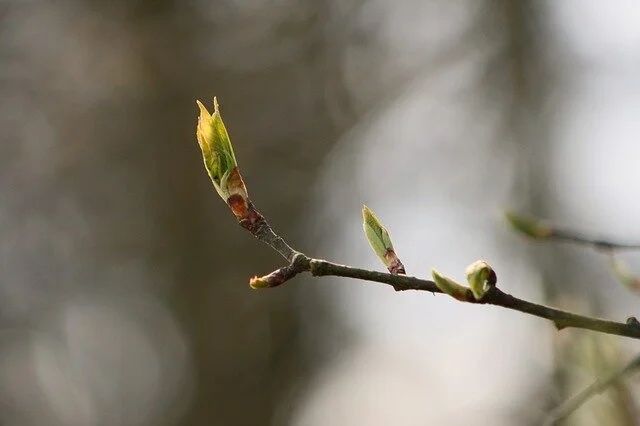
The tree stands naked, and I picture the death of those leaves months ago. I see the ground, still covered by their memory. The pain of their loss is something I’m used to. They died of natural causes; autumn claimed them. But wait. Buds pop from the branches of that tree, I see now as I’m standing under it. And it means life.

Newness has come.

Another tree stands naked, and I picture the death of a man almost two-thousand years ago. I see women, His friends, heading to His new resting place. The pain of His loss is not something they’re used to. He died of unnatural causes; hatred killed him. But wait. Emptiness shines from that grave, they see now as they enter it. And it means Life.

Newness has come!

*Names in this blog have been changed to protect my family and friends in the neighborhood, and in a nod of appreciation to the beloved Swedish author Maj Lindman, I’ve renamed my three blondies Flicka, Ricka, and Dicka.

Lessons in clouds: Part 2

“This was the cloudiest January in Minnesota since 1963,” our pastor said at the start of his sermon.

And my recurring word, clouds, drifted in again. I thought of that 1980s jaunt in the station wagon to see Mount Rushmore. Clouds obscured the presidential faces the day we visited, but they couldn’t block my memories of the trip any more than the hard things in life could blur my dreams.

I shot a look at Husband, not a big cumulonimbus guy, but a meteorology minor (to go with his Aeronautical Science degree back in the day) nonetheless. Even his education sparked thoughts for me of the condensed vapors in the atmosphere.

Clouds were everywhere. So, what other lessons loomed?

I focused on the message again. Pastor talked about clouds over our country in more ways than the physical ones that hovered over our first month of 2021. And if we lived inside of them, depression and despair would turn our views grey and defeat us.

“But because of His great love, we are not consumed,” he said. So, live above the clouds, he urged us; a change of altitude would shift everything.

But even the sunniest among us feel caught in the dismal sometimes—and dampened by our circumstances.

“Turn off the TV, the news,” he said, answering my desire for the practical. “And listen to the voice of the Air Traffic Controller who knows the way through the storm.”

Hope pierced my thoughts like a spear of light through fog, and more faith followed—because it always does when we glimpse our once hidden path again.


Refreshed, I dimmed the temporal things, tuned into the eternal, and a podcast spoke into my week, telling of more clouds. But these were different.

Since we are surrounded by so great a cloud of witnesses, let us run with endurance the race set before us.

The clouds covering Mount Rushmore that day in 1983? An obstruction.

The clouds over the news with its threatening forecasts? A distraction.

The clouds of the faithful—gone before us—who finished life’s marathon well? A motivation. And I want to be like them.

Faith moves us. Hope accompanies us. Intention fuels us.

And the clouds, once dark, clear again.

light-beam-3398105_640.jpg

*Names in this blog have been changed to protect my family and friends in the neighborhood, and in a nod of appreciation to the beloved Swedish author Maj Lindman, I’ve renamed my three blondies Flicka, Ricka, and Dicka.

Lessons in clouds: Part 1

When one encounter after another—in a short span of time—brings up the same topic, I listen. There’s a reason in this season for the recurring subject, and I’m curious why. Does that happen to you too?

The common theme for me these days started last week with a visit from some of my relatives who mentioned a trip to Mount Rushmore. And when I hear Mount Rushmore, I don’t think faces. I think clouds.

Hop in our old wood-paneled vehicle, and let’s go back a handful of decades to relive this one together.

*****

Nothing says family trips in the 1980s like a station wagon without adequate air conditioning.

As the carsick one in my family of seven, I soon learned all the tricks to stave off nausea: “Don’t read in the car”, “Put your head between your knees”, “Take deep breaths through your mouth”, and “Just look out the window”, which was hard to do when my head was dangling between my knees.

Perennially queasy in the warm backseat, I battled my way through childhood trips without asking Dad to pull over—except on June 16, 1983. Winding our way up to visit Mount Rushmore, I was finally out of options.

“Can you stop?” I said, waves of sickness threatening to drown me. “Now?”

I don’t recall Dad’s answer, but he wasn’t pleased by the interruption in our schedule. He pulled the car over and put it into park. I shoved my door open and sprang out. Crouching by a back tire, I emptied my stomach. And I heard it.

I wiped my mouth and climbed back into the car. “Something’s hissing out there.”

“A snake?” One of my siblings said.

Dad got out and took a lap around the vehicle. He returned. “We got a flat tire.”

No one ever said it, but I’m sure the family thought my bout of sickness, however ill-timed, had saved the day.

The tire changed, we continued our ascent to the presidential faces. But the skies, thick with grey clouds, obscured our view.

“Maybe it’ll clear,” Mom said.

For hours, we waited. But the clouds—more stubborn than we were—persisted.

“I guess that’s it,” Dad said, hands on his hips. “Maybe next time.”

We kids snapped pictures of the hidden landscape. At least we knew what the photos were all about, and anyone sifting through them later would just have to take our word for it.


Today, I laugh at the vomiting episode, the flat tire, and our blocked view of the national monument. But isn’t life like this? My days lately have resembled June 16, 1983. The trip up to the stuff of my prayers is winding, and car sickness distracts me. But wait. A flat tire too? And now when I’m almost there, clouds are hovering, obstructing my outlook.

Is this your life too? I have an idea. Let’s capture some snapshots for our scrapbooks anyway—to remind ourselves. Because the longings of our hearts are still there even when we can’t see them.

Everyone else will just have to take our word for it.

cloud-5694354_640.jpg

*Names in this blog have been changed to protect my family and friends in the neighborhood, and in a nod of appreciation to the beloved Swedish author Maj Lindman, I’ve renamed my three blondies Flicka, Ricka, and Dicka.

Mrs. Fitzpatrick

Maybe it was my uncle’s passing last week or maybe it was yesterday’s rain that triggered the memory of my long-ago neighbor. Either way, even after forty-seven years I remember Mrs. Fitzpatrick and smile.

*****

Whenever someone dies, it rains.

Or at least that’s what I decided that day in 1974.

We lived in a big, green house in south Minneapolis—across the street from Seward Elementary School—back then, and Mrs. Fitzpatrick and her sister Inez lived next door.

To my preschool eye, our two neighbor ladies looked ancient. Mrs. Fitzpatrick wore smock tops, and half-moon eyeglasses hung from her neck on a bejeweled lanyard. Her fingers dripped with splashy rings, and when she laughed in her gravelly voice, she flashed silver-capped teeth.

Mrs. Fitzpatrick was good to us kids and allowed us inside her house for visits. The place brimmed with musty knick-knacks and heirlooms, but I was drawn to one picture on her wall: a peacock—its splayed feathers done in shimmering threads—laid to rest on black velvet and framed in ornate gold.

Mrs. Fitzpatrick was the only adult I knew who smoked, and I thought the habit was otherworldly and matched her velvet art. She owned a beaded coin purse, made especially for her pack of cigarettes, and pedestal ashtrays stood at attention by the sofa and chairs in her living room like servants awaiting their lady’s orders.

On Halloween, Mrs. Fitzpatrick treated us kids as guests and not like front-stoop beggars in costume. With a flourish, she swept us into her home so we could choose the candy we wanted. And my older sister Coco counted the old woman as her friend.

While Mrs. Fitzpatrick watered her lawn one day, Coco modeled all her summer clothes for her in an impromptu fashion show. As my sister flounced outside in each new combination, the woman tipped back her head and laughed. Some days, after Coco returned home from her school across the street, she went over to visit Mrs. Fitzpatrick, and the two of them chatted while they worked crossword puzzles on the front porch.

One morning in 1974, a paramedic van with flashing lights pulled up in front of Mrs. Fitzpatrick’s house. My two-year-old brother Fred and I scrambled to our perches on the back of the brown couch and watched the activity through the picture window. Several men from the vehicle traipsed into our neighbors’ home, but the rain pelted the glass, obscuring our view. So Fred—wearing nothing but a diaper—scooted from his post, pulled on a coat, and stepped into Dad’s galoshes by the front door. He tromped outside in the thigh-high boots, and I followed him. We stood side-by-side in the rain in our front yard until the men emerged from the house, carrying a covered something out on their gurney.

Coco came home early from school that day. She had spotted the emergency vehicle when she was outside for recess, and she told her teacher she felt sick. Mom announced the sad news to us kids: Inez had found her sister unresponsive in bed that morning. Mrs. Fitzpatrick had died in her sleep.

A year later, I watched the episode of Little House on the Prairie where the widow passed away, leaving behind her three children. The woman’s voice had been raspy—just like Mrs. Fitzpatrick’s—and rain poured down at her graveside funeral. I again thought of our neighbor’s showy accessories and generous candy dish, her smoke-staled furniture and Coco’s frequent visits. I recalled the scratch of the upholstery on the backs of my legs as I sat with Fred on the brown couch that last morning and the feel of the rain that greened the grass but washed away our friend next door.

Because back then, it always rained when someone died.

glass-97504_640.jpg

*Names in this blog have been changed to protect my family, neighbors, and friends in the neighborhood, and in a nod of appreciation to the beloved Swedish author Maj Lindman, I’ve renamed my three blondies Flicka, Ricka, and Dicka.

The darkroom

“Have we met before?” the author said, scanning our surroundings at the bustling event.

The writers’ conference boasted a large gathering of riveting speakers, notable authors, new writers. And like me, the creatives milling about the auditorium hoped agents, editors, and publishers would notice them. The woman—many books to her credit—waved a finger, motioning to someone behind us. Her gaze drifted back to me.

“A couple of years ago,” I said. “We talked again last year.” And I mentioned a third writerly event where we mingled and where we really connected—or so I thought. We had even exchanged business cards twice.

Without words now, she smiled, but her blank memory had much to say.

Of course she was busy with life and people. Of course she had bigger goals to pursue. Of course it would be difficult to remember an unpublished someone. But my name was unusual enough to spark at least some recollection, wasn’t it?

Baffled by my interaction with the author, I drove home at the end of the conference. Maybe with future publication my memorability would change. I shelved my fears of being forgettable—what good would it do?—and instead mulled over the highlights of the convention.

When the same thing happened with a few different writers at another seminar the next year, though, I let my brain venture into that place. What was going on? Would my visibility change someday when someone offered me a publishing deal? Would people remember my name—or face—then? What did I think I was doing anyway?

Notoriety mattered in the profession, and I wasn’t out there yet. Instead, I worked in life’s darkroom, practicing my skills in seclusion while praying the developing picture turned out beautiful.

But it felt like forever in the dark.


One day while I drove on 35W North to meet a friend, I envisioned my early writings, bound in book form as they stood, and something tweaked my gut. My face heated. Those beginning drafts weren’t developed yet. What if they had gotten out to the public years ago like I thought I wanted, but embarrassment and regret followed? What if the masses read them, raw and unprocessed as they were, and the message didn’t move them? Premature light—too early exposure—would’ve destroyed the final product, stripping its beauty.

What was the darkroom’s purpose? Refinement. What was its offering? Time. What was at its essence? Peace. Blessings hid in the season of being unknown, unnoticed, unseen. And protection rested there.

So, to those of us still practicing our gifts in obscurity, remember this: One Day. And until then, leave the darkroom shut. When it’s right, the One Who opens and closes doors will fling yours—and mine—wide, and the final picture will be worth it.

film-2205325_640.jpg

*Names in this blog have been changed to protect my family and friends in the neighborhood, and in a nod of appreciation to the beloved Swedish author Maj Lindman, I’ve renamed my three blondies Flicka, Ricka, and Dicka.

Travel stories: Hawaii (part 5)

The stars—usually silent—sang that night. And in my spirit I heard their ancient song because they were there at the very beginning when it all went down.

…their voice goes out into all the earth, their words to the ends of the world.

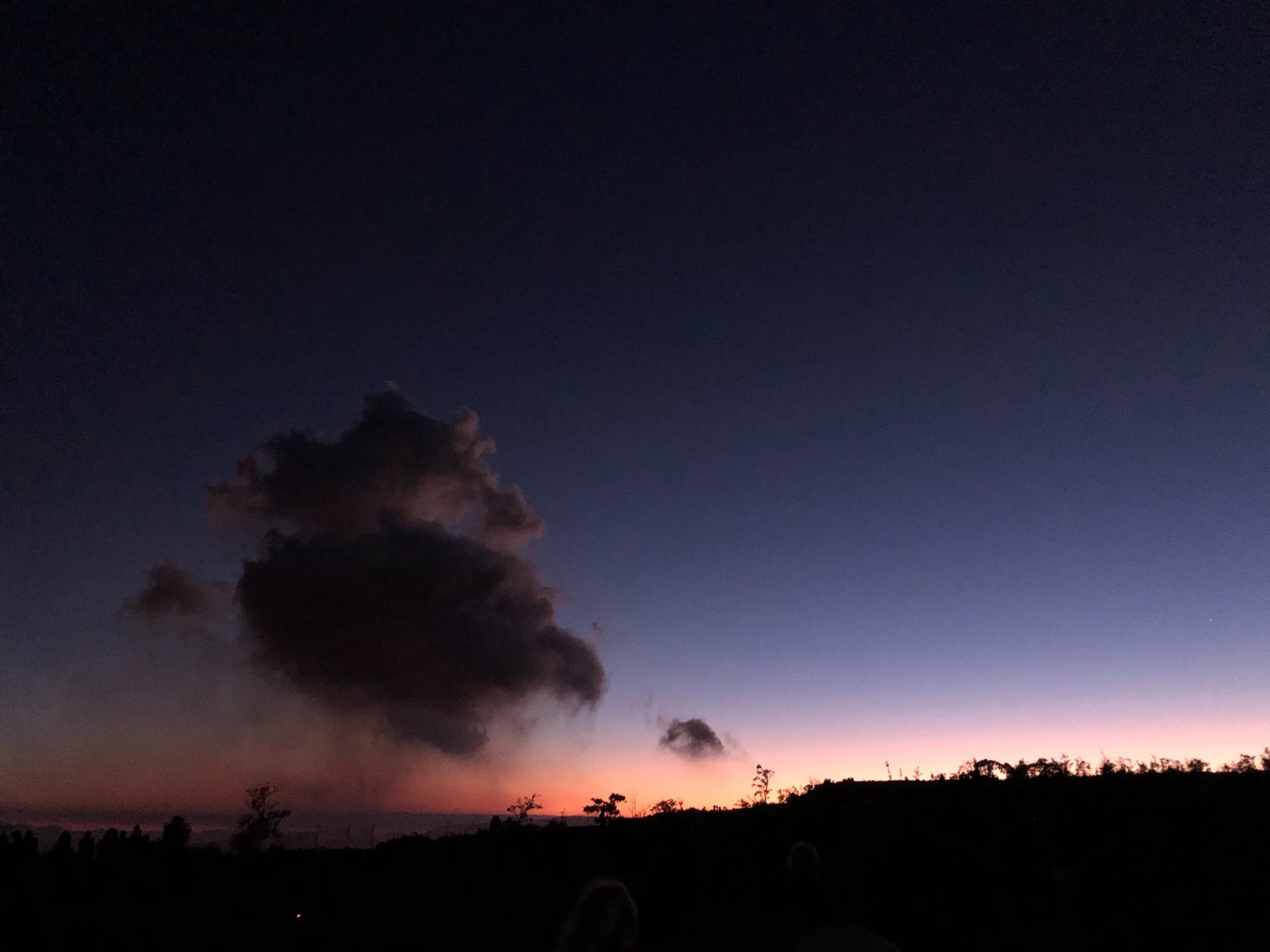
My towel “scarf” served me well on Mauna Kea—or maybe it was the sight of the velvet night with its sequins that stanched the chill. Our family huddled together anyway, our time and place in the cosmos falling away as I breathed in the firmament.

At last, we fumbled down the mountain in the dark and climbed back into the car. As we munched Clif Bars on the drive back to the hotel, our brush with eternity lingered in my thoughts.


They say the Big Island contains eight of the world’s thirteen climate zones—some say more—all in a place the size of New Jersey. In the span of two days, we had hit the tropical in Hilo with its black sand beaches, the dry in Puako where thousands of petroglyphs basked in the sun, and the tundra in the breathless heights of Mauna Kea. Now it was time to go beyond the terrain to frolic with the fishes.

After a lei-making class at the hotel, we headed out to the Keauhou Bay Boat Ramp, but no fancy vessels for us. We would canoe—in the company of two guides—ten minutes out for our manta ray night snorkel excursion. The mantas would be lovely, but I shivered. Exactly what else might happen in the ocean after dark?

We paddled our double-hull canoe, chasing the remains of the sun. An ahi tuna breached, and our female guide hooted. “Hey, that’s the first time I’ve seen that on one of these trips.”

“He dolphinitely did that on porpoise for you guys,” the male guide said. When we laughed, he kept on. “You’re gonna love the manta rays, but too bad you weren’t here last month. We sang ‘Manta Claus is Coming to Town.’ It was a-ray-zing.”

We found our parking spot in the ocean. Soon we’d see the gentle beings up close and personal. Other vacationers floated in nearby boats, their blue lights illuminating the now dark waters beneath them. From a neighboring watercraft arose intermittent man-screams; somebody was probably scared of sea creatures but too excited to stay back in his room.

The guides doled out ankle floaties, which were important, we learned, to keep us on the surface and out of the way of the mantas so we didn’t bump into their skin’s protective coating, causing them harm. We velcroed them around our ankles, tugged our goggles into place, and chomped onto our snorkels. The guides snapped on the boat’s underwater blue lights, and within minutes, the illumination attracted plankton.

“Jump in whenever you’re ready,” the lady guide said.

And we did.

Maybe it was the droplets of water in my snorkel or maybe it was the cool water that caught my breath, but when I came up, I sputtered and choked. I grabbed onto the bar that stretched between the canoes, per the instructions, hoping to slow my breathing. No luck. My feet popped up in front of me, instead of behind where they needed to be for my manta ray viewing. I struggled to poke them back. No luck there either.

Nearby, my snorkeled family fared nicely, each of them face-down on the water, enjoying the show below. I coughed, sucked air in double-time, and continued the La-Z-Boy position. What was wrong with me? And why was I hyperventilating? It was Hawaii, after all, and not like I had plunged into the iciness of Lake Michigan.

Ricka emerged and spoke through her mouthpiece. “You okay, Mom?”

“I don’t know.” More hacking, more huffing, feet still in front. What on earth?

“Everything okay down there?” the lady guide said from her seat up in the canoe.

“I think so.” But she eyed me for the next few minutes anyway.

Finally, normal breathing eased back, and I somehow shot my legs behind me where they belonged. The whole episode took about three minutes, but like those garish vacation shot glasses, embarrassment can be a lasting souvenir. I lowered my face into the ocean like everybody else.

And then came the magic.

One of the stars of our excursion flapped by underneath us. And five more undulated below the surface. Needle fish the length of bananas zipped by, competing with the docile creatures—that can be as long as fifteen feet between wing tips—for plankton.

Thank you for this gift, my heart said.

The mantas—six of them, in total—swished around us for thirty minutes, and the guides knew these six, calling them by name according to their markings and describing their varied personalities because we’re all unique like that.

At last the guides lowered ladders for us, and we climbed out of the water to paddle the ten minutes back to the dock. The mantas had hosted us well in their watery home, and near shore, a turtle greeted us in the shallows, giving us as warm a welcome back to land as we had ever known.


We punctuated our twelve-day trip to the Big Island with Flicka, Ricka, and Dicka’s adventure through UFO Parasailing. Husband and I kept our seats planted on the speed boat, our hair whipping in the wind while we watched the girls soar, ending our trip on a high note for everybody in every way. The two young ones running the parasailing operation promised to post the video of the girls’ flight over the ocean on YouTube in a couple of weeks. Nothing says indelible like a social media keepsake.

We flew back to Minnesota, our skin darker and our outlooks brighter, nothing eventful about our return trip to tag our memories. But every good story ties up its loose ends, and ours was no different.

“Mom,” Flicka said three weeks after our return home. “A lady messaged me through Facebook. She found my ID at the volcano and is sending it back.”

And so, in its spirit of generosity, the island kept giving.


Hawaii, mahalo. You were great, and we’ll see you again someday. In the meantime, we wish “warmth in your hale, fish in your net, and aloha in your heart” to you too.

*Names in this blog have been changed to protect my family and friends in the neighborhood, and in a nod of appreciation to the beloved Swedish author Maj Lindman, I’ve renamed my three blondies Flicka, Ricka, and Dicka.

Travel stories: Hawaii (part 4)

Orange and pink hues hovered over Pololu Valley—at the northernmost tip of the Big Island—and leaked into our new day, peace staining my previous concerns, whatever they were. Who could worry in a place like this? I gazed out as far as my eyes could see, and clouds seemed to form a distant celestial city. I breathed in youth, forgiveness, hope. Sky happened everywhere, so why didn’t I notice it more often at home?

When the atmosphere turned to blues, we left the lookout and hiked the short but steep path down to the black sand beach at the end of the world. Despite the heat, I shivered at the view. No need for signs to tell us the waters were unfit for swimming; the jagged rocks and grey surf said as much on their own. Sacred burial sites lay deeper in the lush forest, and scenes from the show Lost pricked my memories. What if “the others” really existed, heard our movements now, and came after us?

Back in the car, we drove the eight miles to Hawi, a quaint town in North Kohala, where fresh produce and sundresses lured us into a farmers market. We paid $7.00 to a vendor who hacked off the end of a young coconut, so we could sip the water from it. When our drink was gone, the man chopped our fruit in half and sliced a piece from another coconut’s husk for us to use to spoon out its “meat”.

We rolled along the Kohala Coast to Puako Petroglyph Archeological Preserve, a place featuring more than 3,000 ancient Hawaiian rock carvings. Goats grazed on each side of the road as we entered the preserve, and in the parking lot I spied ten cats slinking around cars and trees, the scene spiriting me back to the island of Crete where cats and dogs roamed as they pleased.

“It’s only a 1.4-mile walking trail,” Husband said as we stepped onto the paved beginning of the art gallery of old.

We clicked pictures of the first etchings, sometimes reenacting the stick figures’ poses. Soon, though, the asphalt walk petered out, and the path called for a sure foot and good balance. We stepped over tree roots and lava rocks. We ducked under low tree branches. The way grew rugged, the trail at times indiscernible.

I rolled my ankle. “What was I thinking wearing these sandals?”

“Yeah, what on earth?” Husband pulled a thorn—several inches long—from one of his flip-flops. “Let’s say we’re done.”

Back in the car I reviewed the petroglyph preserve on Trip Advisor: “Wear good shoes.” “Low-hanging branches everywhere, so watch your head.” “Rugged terrain.” “Because of big thorns, don’t wear flip-flops.”

We may not have persevered to the glorious end (or even read about the excursion in advance and worn the proper footwear), but we admired a number of drawings from the hands of long-ago artists, their stories still calling out to us from stone.

And we listened.


If a trip to Hawaii calls for stunning sunrises, surely it begs for striking sunsets too—and stargazing to follow. Husband had done his research and knew exactly where to go to catch some constellations: Mauna Kea Observatory. Even back in Minnesota, he had made a plan and cautioned us all to pack warm clothing to execute it, since temps—yes, even on the tropical island—can dip to 30 degrees at the dormant volcano’s altitude of almost 14,000 feet above sea level.

The summit of Mauna Kea, as the legend goes, was the meeting place of Earth Mother and Sky Father who brought forth Hawaiian children, but at that height, it can also bring on altitude sickness if a human’s not careful.

“Turns out the lack of oxygen can even affect your vision,” Husband said. I frowned. Seriously? “We won’t be going up that far, though.”

We loaded the car with snacks and extra layers—I had learned a thing or two since our hike up to Kilauea—and hopped in the Ford Edge, bound for “White Mountain”, as the name Mauna Kea means in Hawaiian. But first, a stop in Hilo.

We parked the car and ambled around a farmers market in the largest city on the island, eyeing fruits we didn’t know and avocados the size of cantaloupes. In anticipation of the chill to come on the mountain, we found a beach at Richardson Ocean Park where we ate rambutan on our towels on the fine black sand, absorbing the sun’s warmth like we could save it in our skin for later.

Less than an hour down the road, we arrived at Mauna Kea and parked at the visitor’s center, which sat at an altitude of 9,200 feet. Now was the time to don the layers. I climbed out of the car to do it, and the wind lashed me. Within an hour’s time, the temperature had plummeted forty degrees. I tugged on a second pair of leggings and a jacket over my t-shirt, two thermal shirts, and sweater. My body felt fine, but my head? A stocking cap would’ve done nicely. But never mind that now. A beach towel would have to suffice.

We drove further on to a lookout point, the day draining from the sky. We hiked up another 800 feet, and there we perched on rocks, ready for the Divine light switch to snap off—and the event to start. Gusts ripped at my towel head scarf. I leaned into Husband’s side. The girls huddled nearby.

We’re ready, I thought. Show us what You’ve got.


*Tune in next week for the fifth (and final—and I mean it this time!) installment of the story. Mahalo!

*Names in this blog have been changed to protect my family and friends in the neighborhood, and in a nod of appreciation to the beloved Swedish author Maj Lindman, I’ve renamed my three blondies Flicka, Ricka, and Dicka.

Travel stories: Hawaii (part 3)

Catching our breath from the near run-in with a local bird, we tooled along Chain of Craters Road.

“That wasn’t a nēnē,” I said, showing the family the results from my Google search.

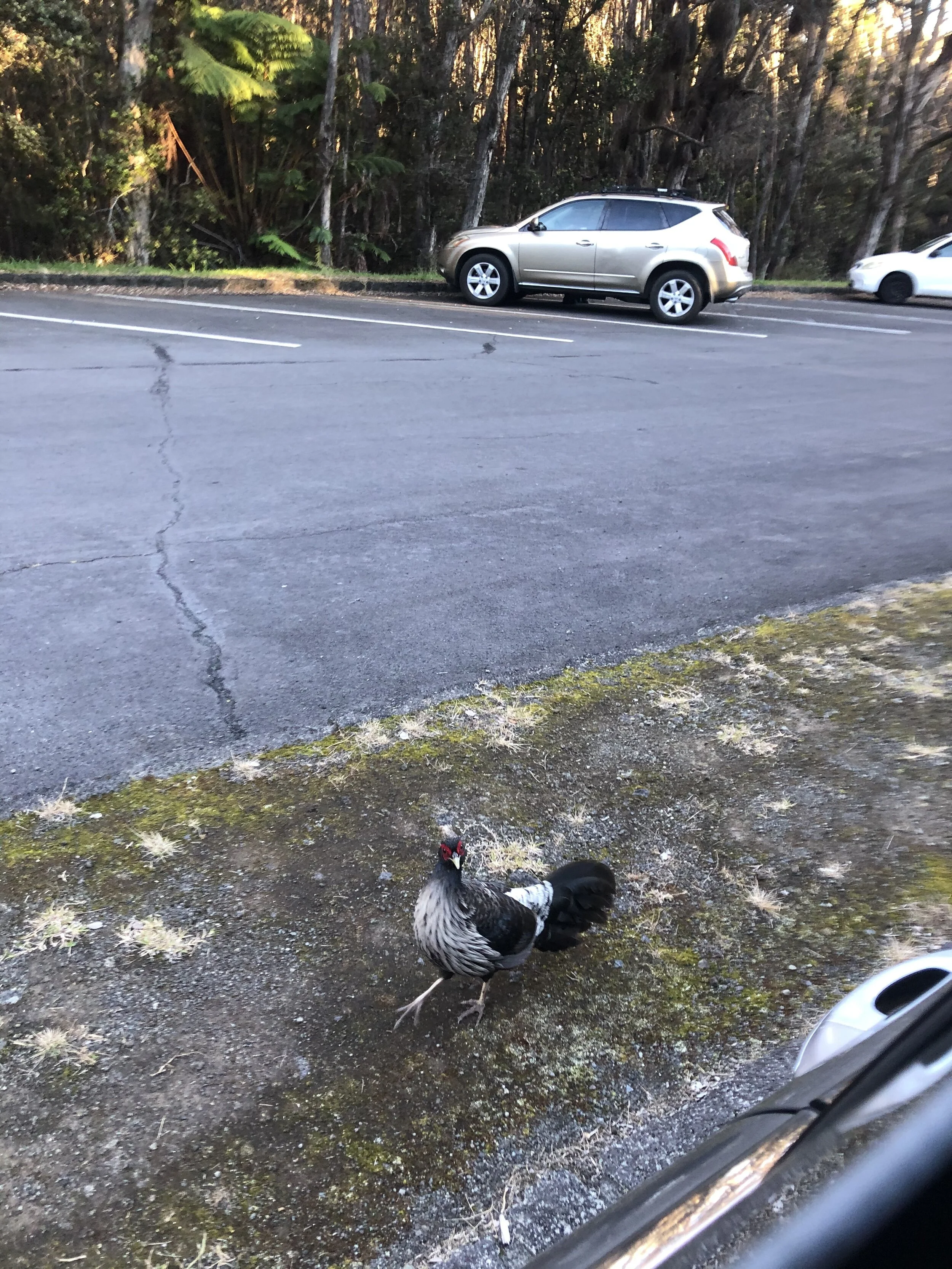
In contrast to the nēnē (the Hawaiian goose with its soft call), the exotic chicken who had rushed our vehicle was the male Kalij pheasant, my phone said, and was often spotted in the Himalayan foothills, from Pakistan to western Thailand, although someone had introduced the species to Hawaii as a gamebird in the early 1960s.

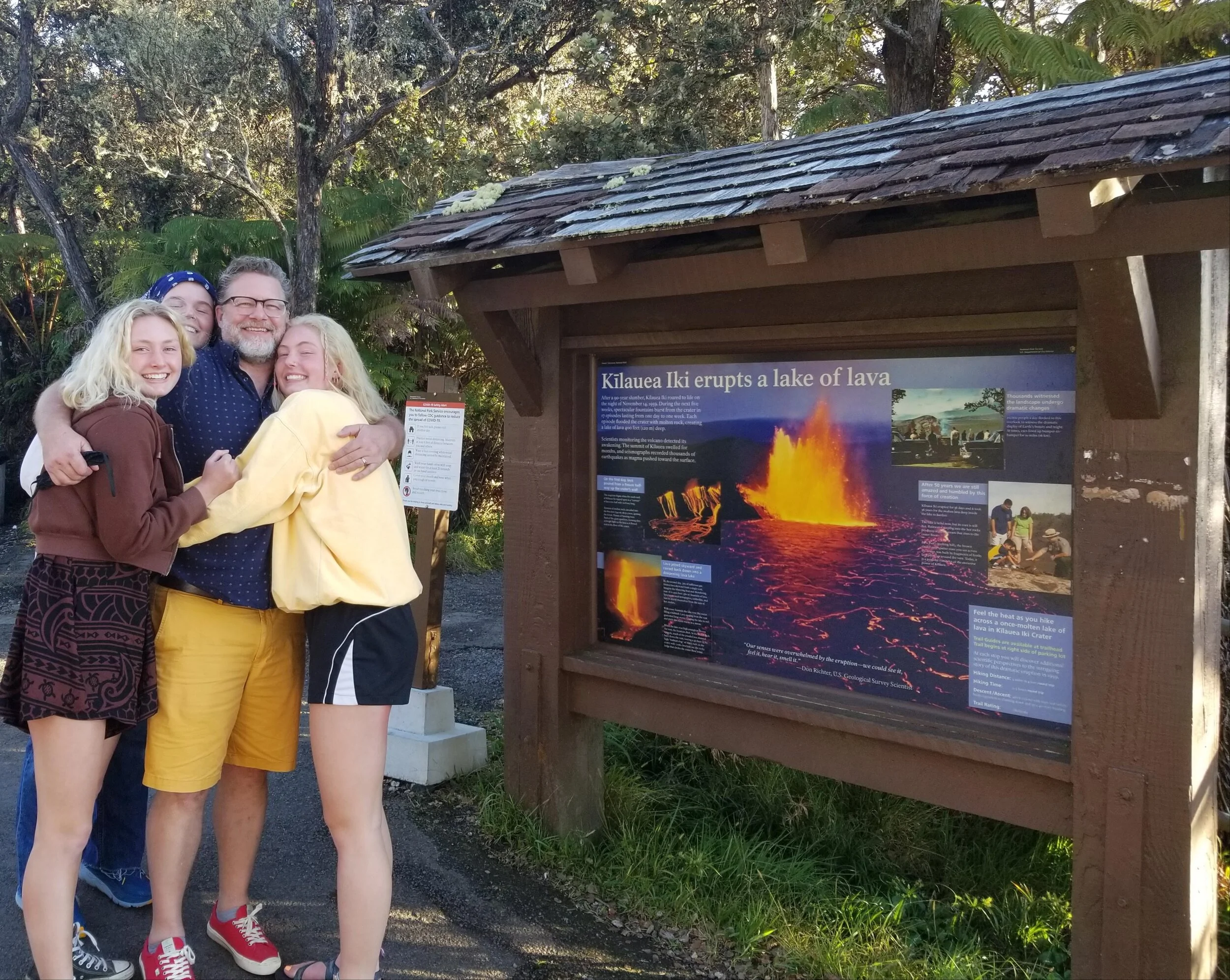
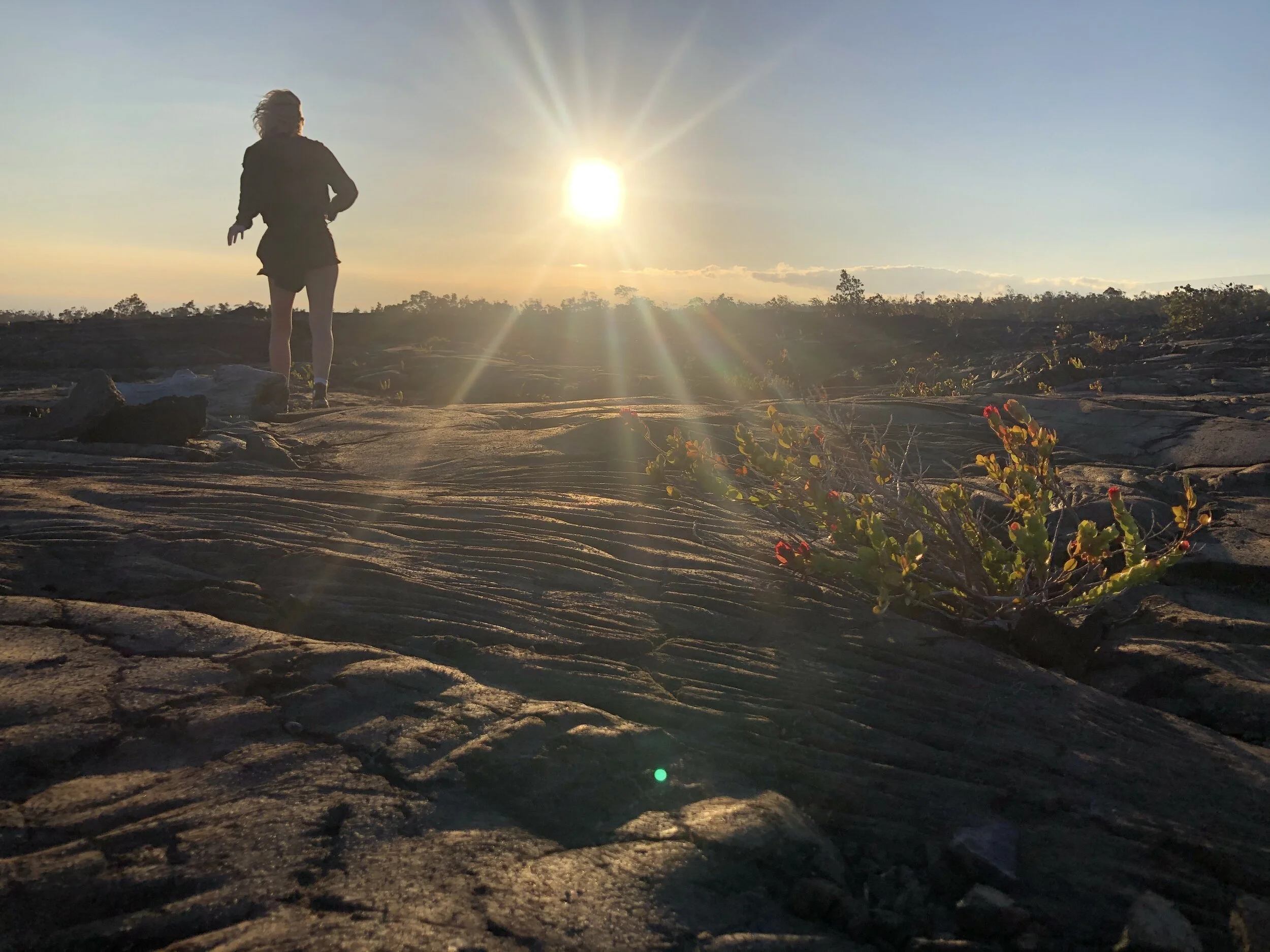
We seized the dwindling daylight and stopped the car to romp in the national park’s fields of lava rock along the East Rift. At one pullout, we snapped pictures of the expansive Mauna Ulu lava flows, blanketing the landscape from 1969 to 1974, now hardened and resembling the moon’s surface. At another, we gazed into the almost four-hundred-foot depths of the Pauahi Crater. Finally, we parked the car, so we could hike up to view the glow of Kilauea, its newest eruption having broken out only a few weeks earlier.

We trekked the paved path for twenty minutes with Flicka hobbling along, the “urchin pieces” in her foot slowing her down. The skies darkened to pitch as we walked, and the wind swept us forward. My mind returned to a familiar vacation subject—appropriate clothing—and to a conversation with Husband before our departure from Minnesota.

“I should probably bring my packable down,” I had said with a wink, dangling the coat for a second over my suitcase.

“Knowing you,” he said, “you probably should.”

But I hadn’t. And on this night’s hike up to the volcano, a pair of shorts, t-shirt, and flimsy jacket weren’t cutting it. I crossed my arms and tightened my abs to stave off the chill.

We arrived at the summit and joined a mass of spectators, but our reward was only a hint of orangey glow emanating from the pit.

“Come back in forty days,” someone at the hotel had told us earlier that day, “And you’ll see the full lava lake of Kilauea.”

On the drive back to the hotel, pinpricks of light shone through the drape of blackness over our car.

“Dance with me under the diamonds,” Justin Bieber serenaded us through the speakers. Even pop music sounded glamorous in a tropical locale. “See me like breath in the cold…”

“Uh, I dropped my ID somewhere up at the volcano,” Flicka announced from the back seat.

Bieber’s voice was smooth, his lyrics timely. “You say that I won’t lose you, but you can’t predict the future, so hold on like you will never let go…”

Ugh. If only Flicka had.


After Ricka, Dicka, and I finished our free thirty-minute hula lesson at the hotel the next day, we all zipped into downtown Kailua-Kona to Body Glove Cruises for our whale-watching tour. The boat was large, the gathering small. The guy on the mic peppered us with humpback whale facts.

“Whale watching should really be called whale waiting,” he said. And over our three-hour session, we practiced waiting while he repeated that same statement a few more times.

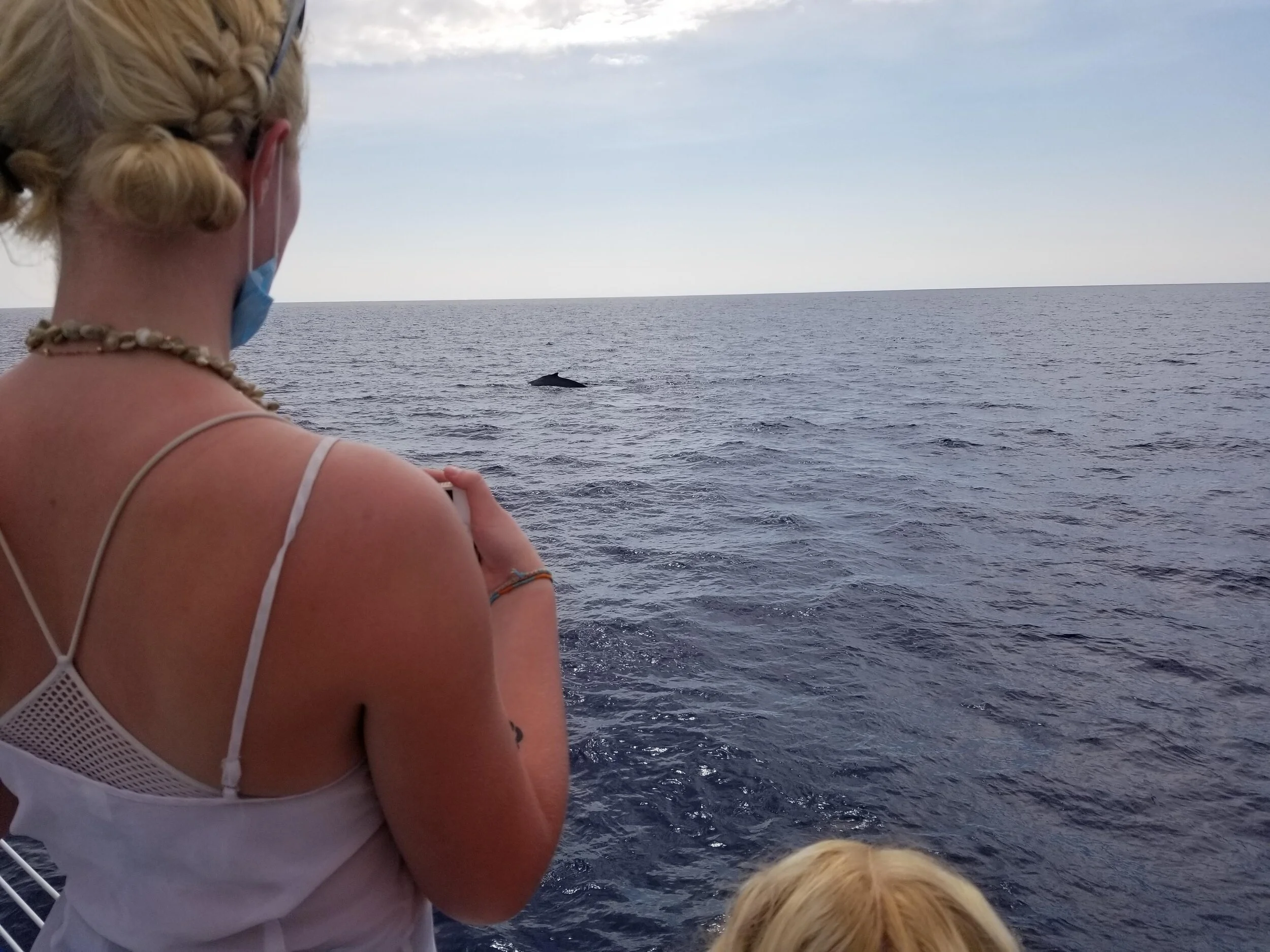
Our guide described Migaloo, the well-known hypo-pigmented humpback whale, and I followed the intriguing sea creature on Instagram. While the famous one has been spotted off the coast of Australia, some have claimed to see the “white fella”—as the aboriginal elders call him—near Maui. But no celebrities for us today. Instead we eyed the usual—but still impressive—grey-colored variety a handful of times, their massive bodies rolling through aquamarine waters, showing us glimpses of backs or dorsal fins, if we were lucky.

On the route back to the port, spinner dolphins showed off near our boat, giving us a grand finale to our sea show. We waved goodbye to the tour crew and strode to the car. The girls scrolled through their phones.

“There’s Pukie and her kids,” Ricka said, pointing at an image.

“Wait. What?” I said, leaning in.

“You didn’t see that lady on the boat?” Flicka said. “She threw up a substantial, singular time.”

Sure enough, I had seen the mother with her two little girls across the deck from us, but hadn’t witnessed the vomiting. A quote from a book blew in: “Sailing is the fine art of getting wet and becoming ill, while going nowhere slowly at great expense.”

Hopefully now the woman felt better—and like we did: the whales were well worth it.


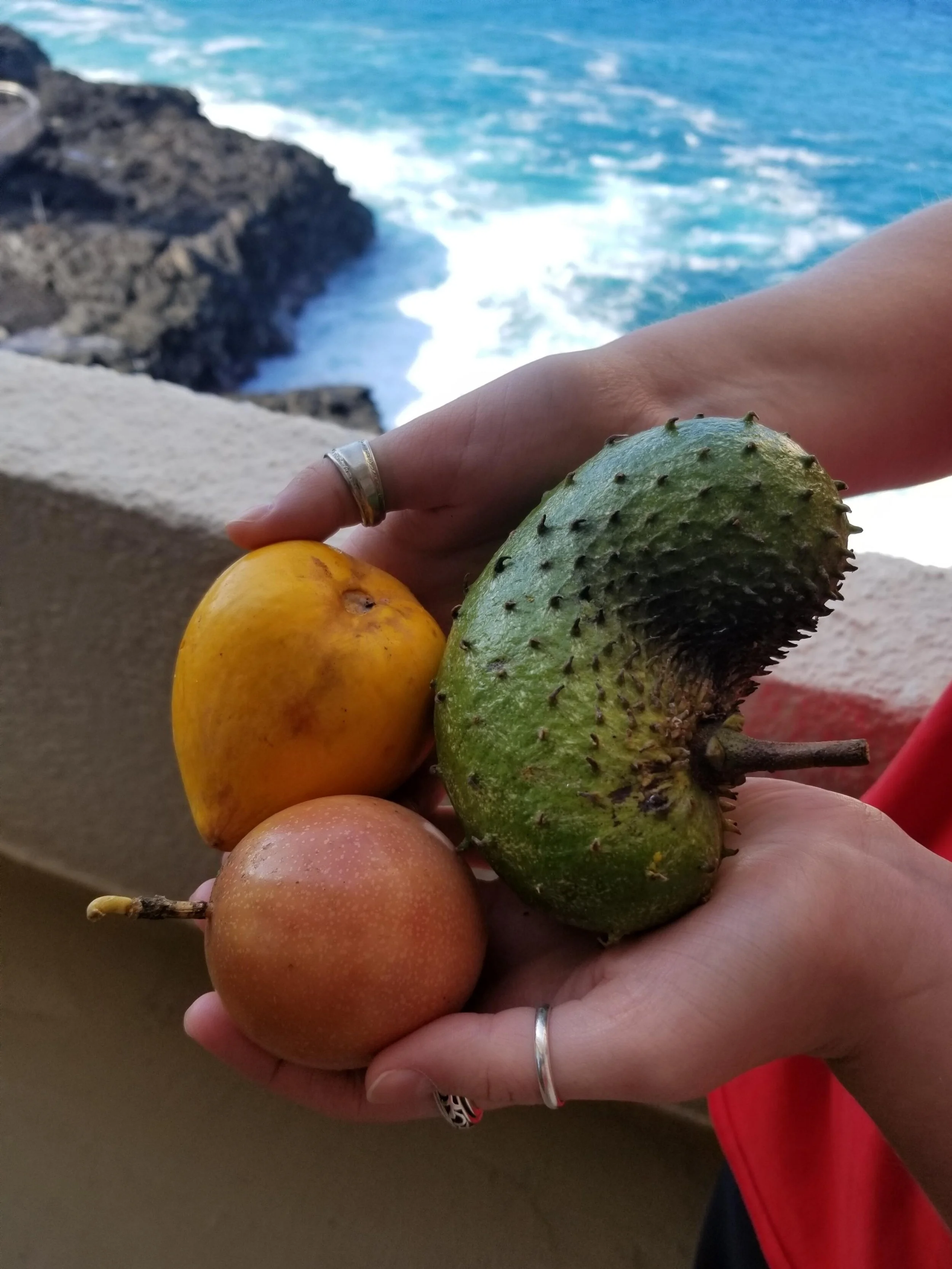
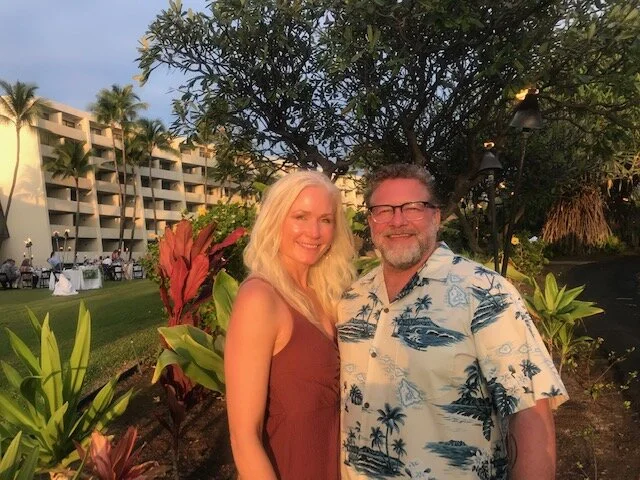
Back at the room, we snacked on fruit—soursop, egg fruit, and lilikoi—from a local farmer’s market while we freshened up for the Haleo Luau on the Sheraton’s grounds. Outside, we located our table on the carpet of grass, and a mongoose skittered across our path. Before taking our seats, though, we ventured toward the ocean and captured forever pictures there, the golden hour photoshopping our skin, lest we forget when Minnesota’s winter winds chap it.

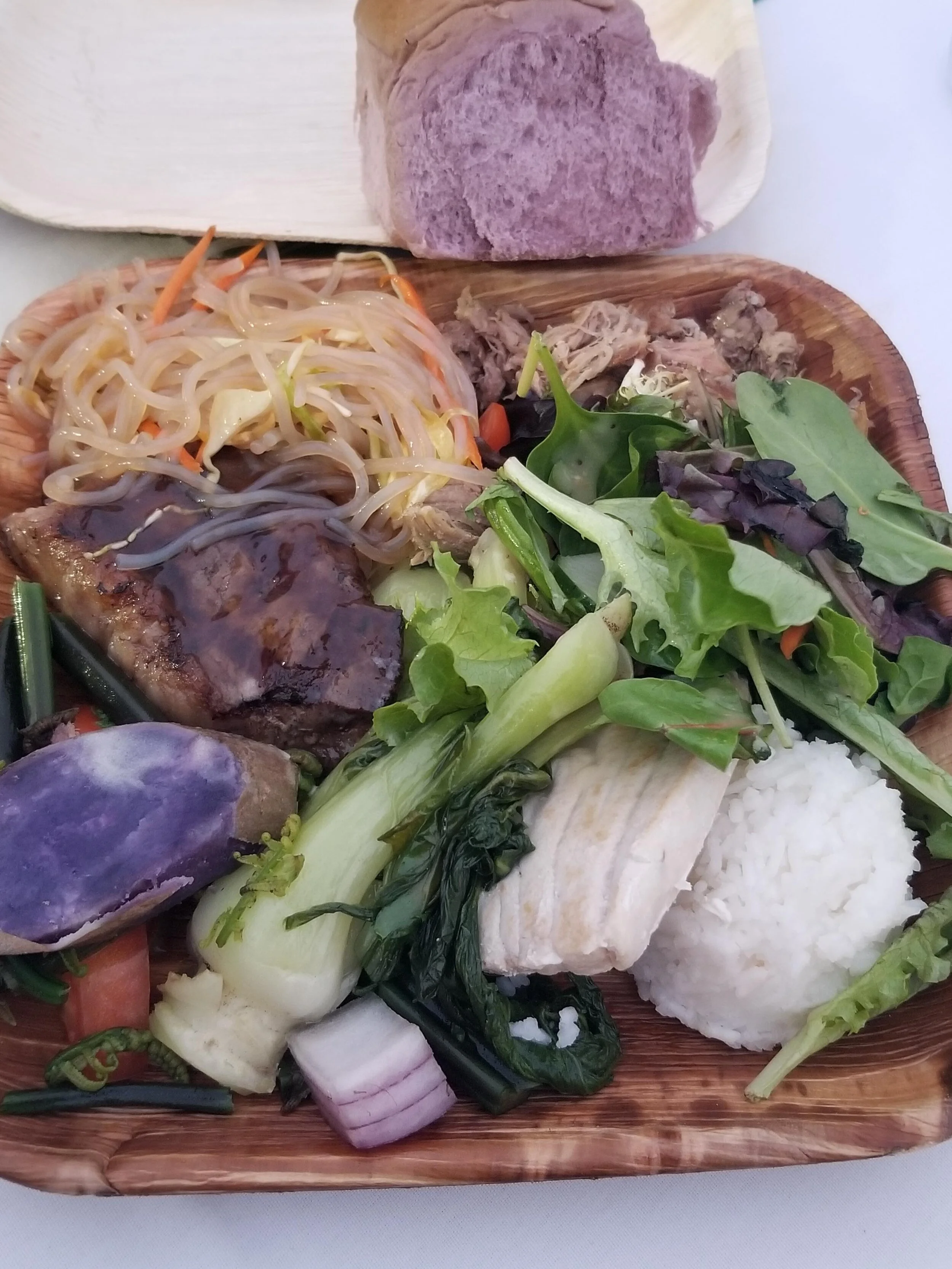
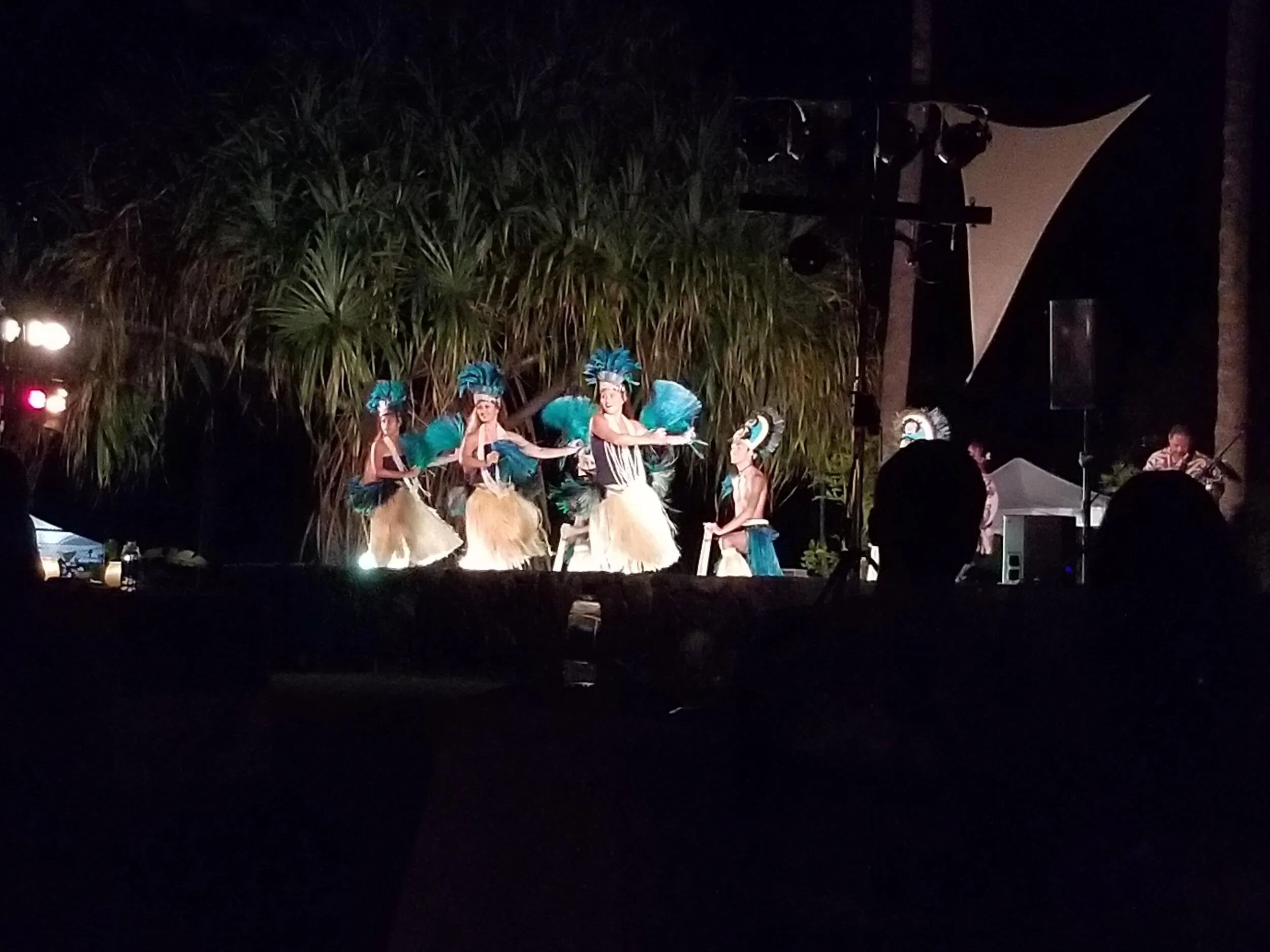
Instead of a buffet experience, our plated feast came to us at the table: taro chips and shoyu poke, lomi lomi salmon and kalua pork, hoio salad and coconut rice, teriyaki New York steak and purple sweet potatoes. Later, over pineapple upside-down cake and haupia (coconut pudding), performers whisked us away with their Polynesian dances and songs. A storyteller carried us through the birth of King Kamehameha III—and into his reign where the royal blended ancient traditions with new—and transported us into the surfing stories of He’eia Bay.

The festivities over, we wandered back to our rooms, flickering torches pointing our way through palm trees, bird of paradise, and red ginger. Scents of passion fruit flower and gardenia escorted us. And there was that crashing beauty again in the darkness—the Pacific blasting against black rocks—restraining her power long enough to allow us to pass.

Husband and I gave up our usual evening on the balcony in favor of sleep. 4:30 a.m. came early, and we needed to rest fast. Sunrise in Pololu Valley—an hour’s drive away—waited for no one.  

We would catch tomorrow’s fresh mercies even as they peeked over the horizon.

*Tune in next week for the fourth (and final) installment of the story. Mahalo!

*Names in this blog have been changed to protect my family and friends in the neighborhood, and in a nod of appreciation to the beloved Swedish author Maj Lindman, I’ve renamed my three blondies Flicka, Ricka, and Dicka.

Travel stories: Hawaii (part 2)

Flight attendants doled out water and stroopwafels to sweeten our two hours parked on the tarmac in San Jose. Finally, we flew back to San Francisco, our trip ending in a successful landing.

The pilot’s voice came over the speaker. “We’re experiencing some mechanical trouble with the jetway. We ask for your patience as we fix the issue.”

We stayed planted in our seats, but nursed zero worries about the additional delay; our flight bound for Kona was already long gone. A vision of a person trudging ankle-deep through wet sand—something I hoped to actually do one of these days in Kona—flashed through my brain.

Six hours later, we boarded a flight—the last one of the day—to Kona. Darkness blanketed us when we landed at 10:30 p.m. When palm trees wave aloha and warm winds kiss your face in open-air terminals, though, who cares what time it is? We snaked through a line with our credentials and proof of negative Covid-19 results and were funneled into another line for more virus testing.

“No news is good news,” the medical technician said as he swirled a long swab in my nostrils. “If you don’t hear from us within the hour, it means you should just focus on having fun.”

In our rented Ford Edge, we buzzed along Queen Kh’ahumanu Highway to our hotel, The Sheraton Kona Resort & Spa at Keauhou Bay, in Kailua-Kona. No phone calls came from the airport medics to rattle our plans. At last we checked into our suite with an ocean view, and I dropped my baggage on the floor of our room on my way to the main attraction. I slid open the glass door and stepped onto the balcony to see it.

Shrouded by night, “the deep calling to deep” crashed against lava rocks, majesty exploding the shores far below. I shuddered and breathed in the mystery of the beyond.

Sometimes creation leaves a dent in one’s soul.


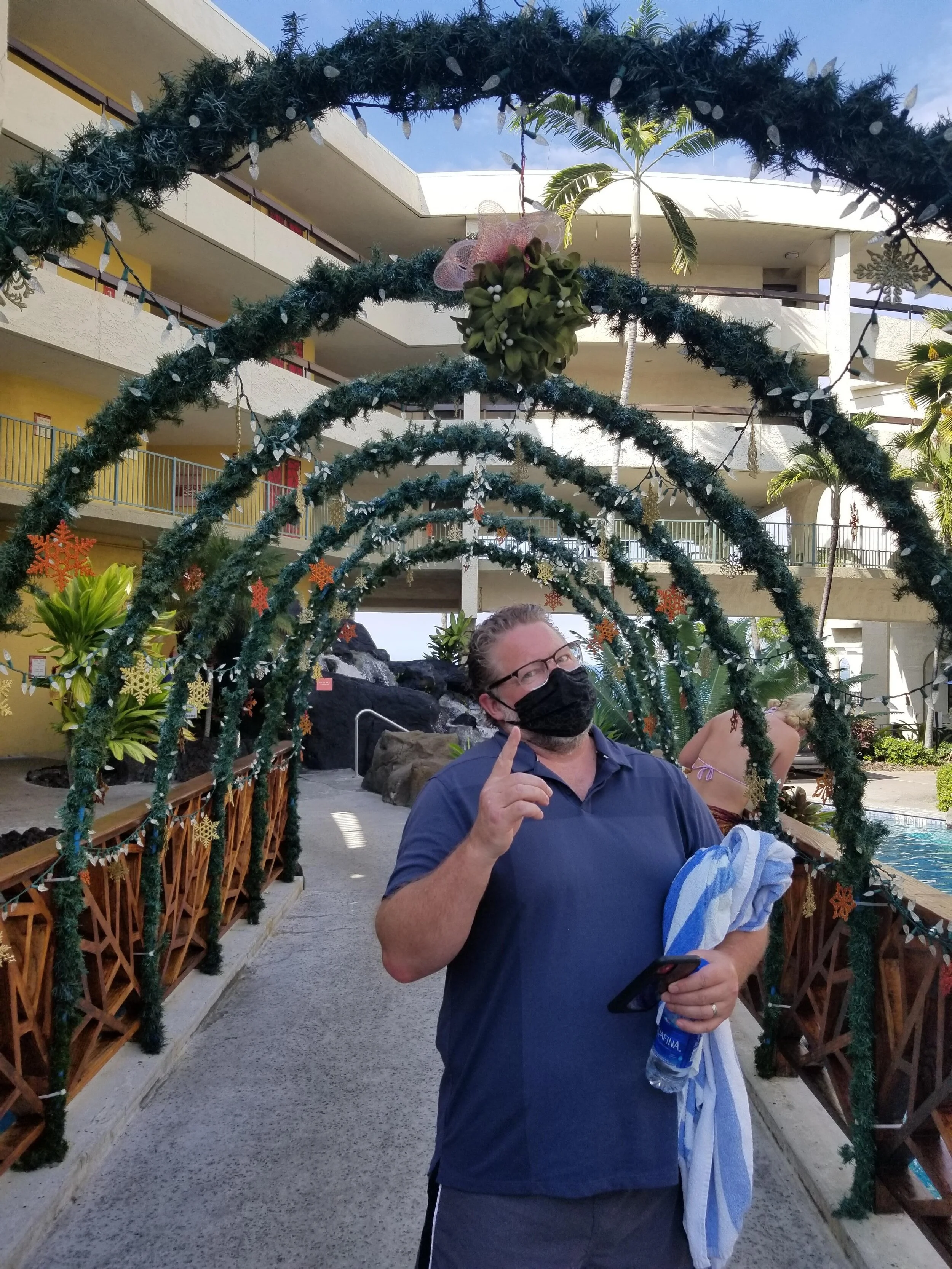
In the morning, we explored the hotel grounds. Tropical foliage dotted the open-air lobby, and swimming pools meandered throughout the manicured property. Christmas decorations draped pillars and entrances, reminding us where we really stood on the calendar. The shell leis the hotel gave us upon arrival dangled around our necks, and the temperatures in the low eighties beckoned us toward the waves.

“I have to tone my hair first,” Ricka announced back in the room as we packed our bags for the beach.

Say it isn’t so, I wanted to tell her. But instead, “You brought the coloring stuff here?”

She nodded, and Flicka and Dicka joined her in the bathroom. Maybe with a rest day and all the coconut oil, her yellow locks would survive this next assault. But what about the sun, salt water, and chlorine to come? Was insult to injury coming too?

Ricka emerged thirty minutes later with natural blonde hair. No hair loss today, thank goodness. And the yellow was gone.

I smothered my shock at the results. “Wow. Looks good.”

We scrambled to Magic Sands Beach—only one of its many names, I learned—and met up with nature’s power in the big surf. The sun warmed our winter skin, and waves shoved us off-balance. And as breezes ruffled our hair, gratefulness swelled in me that we all still had some left on our heads to ruffle.


We awoke the next day to emails containing the outcomes of our Covid-19 saliva tests from the morning of December 31: negative, times five.

“Not exactly rapid results,” I said, sipping my coconut-flavored coffee on the balcony.

“Not even remotely,” Husband said.

Dicka popped her head into our conversation. “We’re heading down to the ocean to swim.”

I smiled. “We’ll be down soon. Be careful.”

Husband and I lingered over our javas. I secured luau reservations for later in the week while he added sunrise and star-viewing jaunts to our agenda. His phone pinged.

“Is she all right?” he said to someone on the other end of the line. “Okay, we’ll come right down.” There was the pit in my stomach again. He clicked off the phone. “That was Ricka. Flicka stepped on a sea urchin. I guess she’s crying.”

Before hiking out to the rocky beach to assess the situation, we made a stop at the front desk.

“So, our daughter stepped on a sea urchin,” Husband said to the woman behind the counter. “Anything you recommend for that?”

“I mean, it’s an old wives’ tale,” she said, “but maybe pee on it?” Wasn’t that the treatment for jellyfish stings? Or was that the healing answer for most sea-related injuries? “Or you can try the Urgent Care up the road, but I don’t think they’d do much for you.”

We thanked her and picked our way down the jagged landscape to where Flicka sat on a rock, staring at the sole of her foot.

“You okay?” Husband said.

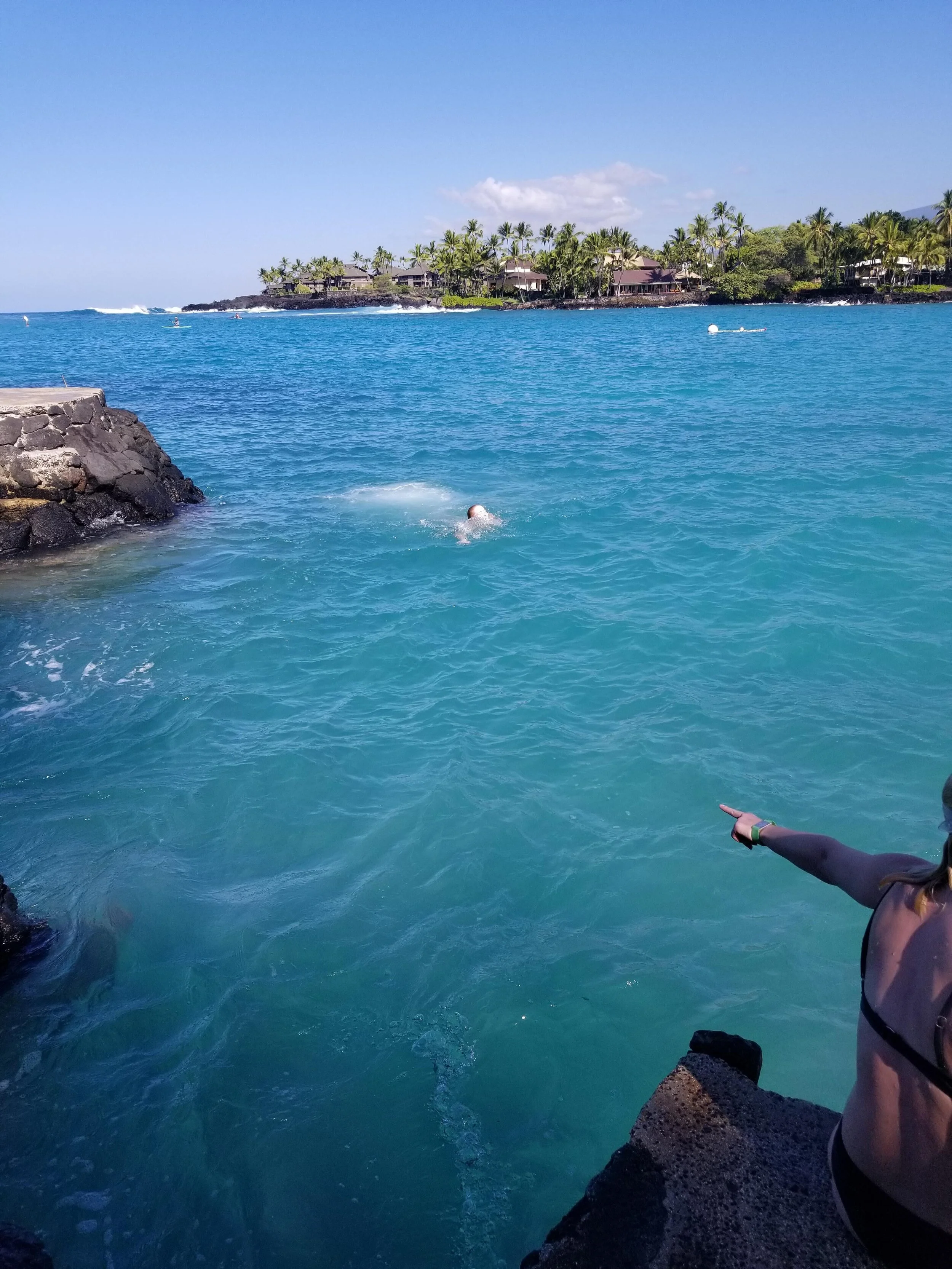
A few tears, a treatment decision, and soon Husband accompanied our limping oldest to the car. I stayed back with the two blonde fish who sprang from black rock ledges into turquoise waters. They surfaced for sips of air before climbing out to do it again—and again.

Later, Husband and Flicka returned from their Urgent Care trip with a tinfoil pan and a jug of something.

“Apparently a vinegar soak will dissolve the spines in her foot faster,” he said.

“The doctor said legends out there say the bits of sea urchin will grow a new body inside you,” Flicka said with a chuckle. “They won’t.”

I wasn’t worried. I pictured the unfortunate sea urchin, though, minding his business, submerged and clinging to a rock like he did every day, until a foot came at him, breaking off his needles. Poor guy.

And my poor girl too.


We drove to Volcanoes National Park, timing our arrival for an hour before dusk. The highlight was the active volcano—the new eruption of Kilauea—visible after dark, we’d been told. Inside the entrance to the park, we pulled into a lot and sat in the car while we viewed a brochure, planning what we’d see in our last hour of light.

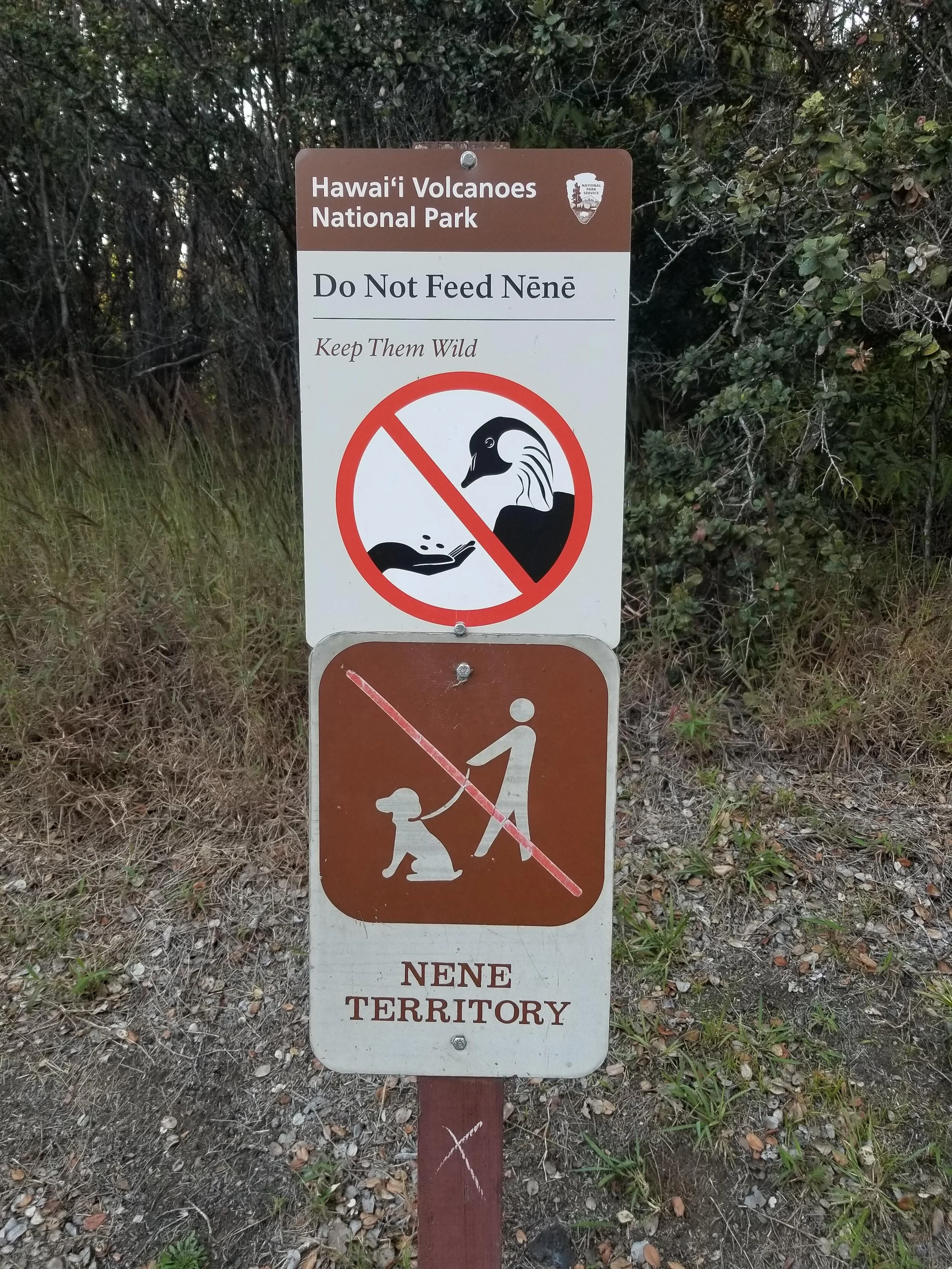
“I wonder what a nēnē is,” I said, pointing to a nearby sign. From the picture, the nēnē looked like a goose, and we were supposed to keep it wild and not feed it. But there was another slashed-out image on the sign too: a person with a dog on a leash. “So, no dogs can be on leashes around the nēnē? Or what?”

“Hey, there’s one of them,” Dicka said from the back seat. About ten feet away from the left side of the car was something resembling an exotic chicken.

The girls lowered a window, and several of us grabbed our phones to capture the moment. Like a celebrity tired of the paparazzi, though, the bird’s head swiveled our way, its gaze lasering in on us, and it charged our vehicle with surprising speed. What was happening?

“Dad, go!” a few people from the back seat hollered. Frantic, Ricka pecked at the button to roll up the window.

“What on earth—?” Husband threw the car into drive, mashed the accelerator, and we peeled away toward Chain of Craters Road.

*Tune in next week for the third installment of our Hawaiian adventures. Mahalo!

*Names in this blog have been changed to protect my family and friends in the neighborhood, and in a nod of appreciation to the beloved Swedish author Maj Lindman, I’ve renamed my three blondies Flicka, Ricka, and Dicka.